
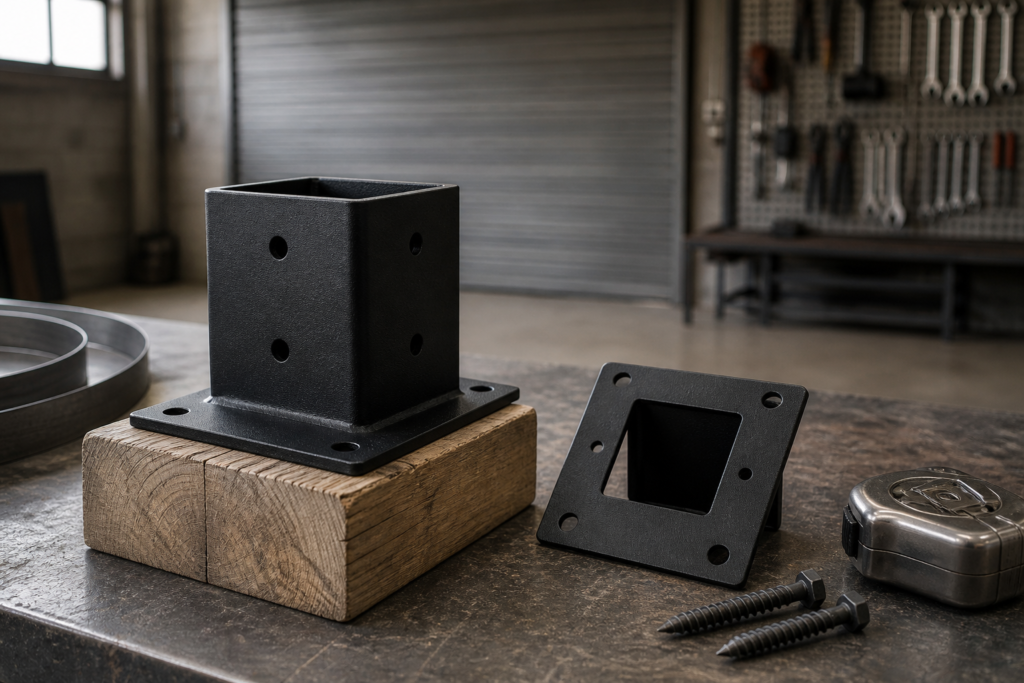
A reliable pergola bracket kit BOM is a controlled procurement record that connects every component family to an approved drawing revision, buyer-defined acceptance requirement, packaging level, label record, and inspection document. Do not begin with an assumed “standard kit” or copy quantities from a catalog image. Begin with the buyer’s kit configuration, map each required function to a documented component family, approve a physical sample, and release shipment only when the evidence pack matches the current BOM revision.
This checklist is for OEM buyers, sourcing teams, quality engineers, and suppliers building repeatable kit-level controls. It does not prescribe a universal kit, component count, or SKU because those depend on the buyer’s structure and sales configuration. Product selection belongs on the metal pergola bracket category; this article starts after the commercial scope has been defined.
Define the kit boundary before creating the BOM
The kit boundary answers one operational question: what must be present, identified, and traceable when one saleable OEM kit leaves the factory? Write that boundary as a short statement approved by procurement, engineering, quality, and packaging. It should identify the target market, kit configuration name, unit of sale, included component functions, included hardware categories if applicable, document pack, and packaging endpoint.
Keep kit-level process control separate from structural design decisions. Requirements involving loads, bolt specifications, or spans require their own engineering workflow; Jiansen provides a separate reference on heavy-duty bracket engineering questions. Likewise, base fixing and exposure requirements belong in a separate anchoring review, not in an invented generic kit definition.
Record assumptions as open items, not facts
If a drawing, fastener schedule, finish code, language requirement, or pack quantity is missing, mark the field “TBD—buyer approval required.” Assign an owner and due date. A blank field can disappear during handoff; a controlled open item remains visible. Never convert a website photo, carton example, or previous customer order into an approved requirement without written authorization.
Run the OEM kit release as a gated process
A gated process prevents purchasing, production, and packing from working from different assumptions. Each output becomes the input to the next gate.
| Gate | Primary action | Required output | Release question |
|---|---|---|---|
| 1. Scope | Define the saleable kit and exclusions | Signed kit-boundary statement | Does every stakeholder understand what one kit means? |
| 2. Map | Map required functions to component families | Family map with approved references | Is every line based on documented source data? |
| 3. Build | Create the controlled BOM | BOM revision with open-item log | Are quantities and attributes buyer-approved? |
| 4. Sample | Assemble and review a representative kit | Signed sample approval record | Does the sample match drawings, pack plan, and labels? |
| 5. Freeze | Lock production and packaging inputs | Released master data set | Can the factory reproduce the approved sample? |
| 6. Inspect | Inspect shipment against current records | Inspection evidence pack | Is objective evidence complete and revision-correct? |
| 7. Close | Approve release or contain deviations | Release decision and deviation log | Are exceptions formally accepted or corrected? |
Map component families without inventing a standard kit
Component family mapping is a classification step, not a bill of quantities. It links each buyer-required function—such as a corner connection, beam interface, cap, or hardware group—to the drawings and records that can fulfill it. Only after that mapping is reviewed should the buyer authorize exact kit lines and quantities.
Jiansen’s verified public catalog illustrates why nominal labels are not enough: it contains 23 models, including 17 in the 92 mm family and four in the 153 mm family. X4 and X5 use a 92.5 mm actual design, and the catalog also identifies a 47 mm beam opening. W1, W2, and W3 are listed as 2.3 mm light-duty variants. These are useful master-data distinctions, but they do not establish what any buyer’s kit contains.
Normalize dimensional identity in the family map
Store nominal family, actual controlled dimension, compatible post convention, and drawing reference in separate fields. The 92 mm family may be associated with 90 mm metric posts and 88.9 mm US 4×4 material. The 153 mm family is directed toward 150 mm metric material. A US 6×6 is 139.7 mm, so a standard 153 mm item must not be described generically as fitting US 6×6. A 143 mm customization has historical commercial confirmation at 50 pieces without a tooling fee, but that historical fact is not a universal quotation, MOQ, or current-order approval; request written confirmation for each project.
For help distinguishing broad product families before BOM work begins, see the metal bracket selection overview. Once the family is chosen, return to controlled drawings and buyer-approved requirements.
Build the BOM with auditable fields
The BOM should let an independent reviewer answer: what is the item, which revision controls it, how many belong in one buyer-defined kit, how is it verified, and where is it packed? Use one row per distinct controlled item. Do not merge visually similar parts if their drawings, finishes, labels, or packaging differ.
| BOM field | What to enter | Control rule |
|---|---|---|
| Kit ID and kit revision | Buyer-controlled identifier and revision | Must appear on approval and inspection records |
| Line number | Stable sequence number | Never reuse a retired line for a different item |
| Buyer item ID | Buyer part number or approved placeholder | No supplier substitution without authorization |
| Supplier model reference | Catalog model only when verified | Link to current drawing, not only a product image |
| Component family | Controlled family and function | Separate nominal label from actual dimensions |
| Description | Plain-language identity | Avoid unverified compatibility claims |
| Drawing/specification revision | Document number and revision | Must match released production documents |
| Quantity per kit | Buyer-defined approved value | Never infer from photos or another kit |
| Finish/color code | Buyer-approved code and reference | Use an agreed comparison method |
| Acceptance method | Measurement, visual check, count, or document review | Acceptance limits remain buyer-defined |
| Packaging level | Unit, inner pack, master carton, or logistic unit | Connect to packaging specification revision |
| Label template ID | Approved artwork/data template | Include language and barcode version where relevant |
| Traceability field | Lot/batch rule defined by buyer and supplier | Must connect physical goods to records |
| Status | TBD, sample-approved, released, superseded, or blocked | Only released lines may enter production |
Control revisions as one linked data set
A kit is controlled by more than a BOM revision. The release set normally includes the BOM, component drawings, specification sheets, artwork, packaging instruction, label template, sample record, inspection plan, and approved deviations. Maintain a document index showing each file’s identifier, revision, owner, approval date, and effective order or production batch.
Use a practical change-control checklist
- Identify the requested change and business reason.
- List every affected BOM line, drawing, label, carton, instruction, and inspection record.
- Assess existing raw material, work in progress, finished stock, and printed packaging.
- Decide whether a new sample or partial reapproval is required.
- Obtain named approvals from authorized buyer and supplier roles.
- Set an effective order, batch, or date and define treatment of old revision stock.
- Update the master document index and withdraw obsolete controlled copies.
- Verify the first production lot under the new revision.
- Archive before/after evidence and any approved deviation.
Supplier qualification should confirm that document control works in practice. The workflow in this Chinese hardware supplier verification guide offers transferable audit questions even though the example product category differs.
Approve a physical sample before production release
Sample approval converts documents into a reproducible physical reference. The approval record should identify the kit ID, BOM revision, every referenced document revision, sample date, reviewer, deviations, photographs, and disposition. A “looks good” email is not sufficient because it does not define what was reviewed.
Sample approval checklist
- Confirm the sample’s kit ID and BOM revision.
- Reconcile every physical item to an approved BOM line.
- Verify buyer-defined quantities without assuming a catalog pack is a complete kit.
- Confirm model and component-family identity against drawings.
- Record dimensional and visual results using buyer-defined acceptance values.
- Verify finish/color reference and approved workmanship criteria.
- Check included documents and language versions.
- Assemble the packaging hierarchy in the intended sequence.
- Scan or read labels and reconcile their data to the master record.
- Photograph contents, protection, closures, labels, and sealed package.
- Record every deviation and its authorized disposition.
- Sign approval, rejection, or conditional approval with named owners.
Keep the approved sample or a documented reference set under controlled storage, with rules for replacement and expiry. If the sample changes, trigger change control rather than silently updating production.
Specify the packaging hierarchy from item to logistic unit
Packaging hierarchy is the parent-child map showing where every BOM line is placed and how lower levels roll up into shipment units. A typical hierarchy can include component protection, unit kit, inner pack, master carton, and pallet or other logistic unit. The actual levels and quantities are buyer-defined; omit levels that do not apply.
| Level | Record | Evidence to retain |
|---|---|---|
| Component protection | Part orientation, separator/bag, contact protection, and identification | Approved instruction and sample photos |
| Unit kit | Included BOM lines, count method, documents, closure, and unit label | Pack audit sheet and sealed-kit photo |
| Inner pack | Child unit identity and buyer-defined quantity | Count record and label image |
| Master carton | Contained kit IDs/revisions, packing pattern, closure, and carton label | Carton audit, dimensions/weight if specified, and photos |
| Logistic unit | Carton relationship, unit identifier, stacking/wrap rules, and shipping mark | Unit map and dispatch photos |
If solid wood packaging material is used in international trade, review the official IPPC guide on wood packaging material and ISPM 15. Do not infer compliance from wood appearance; obtain the required evidence for the actual shipment and destination.
Define label data before artwork approval
Artwork is the presentation layer; label data is the controlled source. Create a label data dictionary before approving visual layouts. The dictionary should state field name, source system, format, allowed values, responsible owner, validation method, and packaging level.
Candidate fields include buyer name, kit description, buyer item ID, kit revision, supplier model reference where authorized, quantity and unit of measure, country-of-origin statement as legally applicable, lot/batch identifier, production or packing date format, purchase order, carton sequence, destination, handling text, label template revision, and barcode data. Every used value must come from an approved source; not every field is required for every order.
For logistic-unit identification and placement principles, consult the GS1 Logistic Label Guideline. Apply only identifiers and data structures authorized for the buyer’s implementation. During approval, test human-readable text and scan performance, then store a verified label image with decoded data.
Assemble a shipment inspection evidence pack
The evidence pack should allow a buyer to reconstruct what was inspected, against which revision, using which sampling instruction, and with what result. ISO 2859-1:2026 provides an official framework for sampling procedures for inspection by attributes. Reference the ISO 2859-1:2026 standard page, but do not invent an AQL, inspection level, switching rule, or sample size. Those values must be selected and documented by authorized parties for the specific order.
Shipment inspection evidence pack contents
- Purchase order and released kit BOM revision.
- Master document index with drawing, packaging, and label revisions.
- Approved sample record and approved deviations.
- Production lot/batch and carton-to-lot traceability map.
- Buyer-approved inspection plan and sampling instruction.
- Item reconciliation and kit completeness results.
- Recorded measurements and visual inspection results against buyer-defined criteria.
- Packaging hierarchy audit and count evidence.
- Readable label photographs plus barcode verification where applicable.
- Photos of sampled open kits, sealed kits, master cartons, and logistic units.
- Nonconformance, containment, rework, and reinspection records.
- Final release authorization identifying reviewer and date.
Evidence should be legible, time-linked, and revision-linked. A photo without a kit identifier or carton reference is weak evidence. A spreadsheet without document revisions cannot show whether the correct configuration was inspected.
Release, contain, or reject with documented authority
At shipment review, there are only three defensible outcomes: release, contain pending correction, or reject. Conditional release requires a documented deviation that identifies the affected quantity or lots, the accepted condition, approval authority, and any follow-up action. Verbal permission should be converted to a controlled record before dispatch.
For a project-specific BOM review, buyers can contact Jiansen with the proposed family map, drawings, packaging levels, label requirements, and inspection expectations. Supplying controlled inputs first makes the response more precise and prevents a preliminary discussion from being mistaken for an approved kit.
Use this final procurement handoff checklist
- The kit boundary and exclusions are signed.
- Every BOM line has an approved source record and status.
- Quantities are buyer-defined and not inferred from public examples.
- Family dimensions and compatibility descriptions are normalized.
- All document revisions are linked in one master index.
- Open items have owners and block release when necessary.
- The physical sample is reconciled to the current BOM.
- Packaging parent-child relationships are documented.
- Label fields have approved sources and validation rules.
- The inspection plan states its authorized sampling instruction.
- The shipment evidence pack is complete and traceable.
- Changes and deviations have named approval authority.
Frequently asked questions about pergola bracket kit BOMs
What is a pergola bracket kit BOM?
A pergola bracket kit BOM is a revision-controlled list that defines the buyer-approved items in one saleable kit and links each line to drawings, quantity, packaging, labels, traceability, and acceptance records. It should not be reconstructed from product photos or a generic catalog pack.
Should an OEM buyer start with a standard kit quantity?
No. The buyer should define the intended structure and saleable configuration, then approve each BOM line and quantity. Public model or carton information may support master-data checks, but it does not prove the contents of a complete OEM kit.
How should component families be recorded?
Record the controlled family, actual dimensions, function, supplier model reference when verified, buyer item ID, and drawing revision in separate fields. Keep nominal market labels separate from measured or drawing-controlled dimensions to prevent compatibility errors.
What must be approved in a kit sample?
Approve item identity, buyer-defined quantities, drawing revisions, workmanship criteria, finish reference, document set, packaging sequence, label content, traceability, and all deviations. The record should include reviewers, dates, results, and photographs tied to the kit revision.
What belongs in a shipment inspection evidence pack?
Include the purchase order, current BOM and document index, sample approval, lot traceability, inspection plan, sampling instruction, results, packaging and label evidence, nonconformance records, shipment photographs, and final release authorization.
When does a BOM change require a new sample?
A new or partial sample review is appropriate when the change can affect item identity, fit, appearance, included documents, packaging, labeling, traceability, or inspection. The authorized buyer and supplier teams should document the scope of reapproval through change control.
