
Short answer: Verify a supplier in this order: business license and export records, real factory evidence (not a trading office), load-rating documentation with a stated safety factor, material certificates for steel grade, sample evaluation of rollers and track, certification package (ISO 9001, RoHS, SGS/CE), and a written QC + warranty process. A manufacturer that publishes these — like Jiansen Hardware, which lists ISO 9001, 8 utility model patents and 150 kg load ratings with a 50% safety margin — passes the paper test; the sample test then confirms it.
Wholesale buyers lose money on Chinese hardware in exactly three ways: the “factory” is a trading company marking up real factories, the published load rating collapses under real doors, and the finish fails salt spray within a year. This checklist attacks all three before you commit a container.
Step 1: Confirm the Entity Is a Manufacturer, Not a Trader
Ask for the business license and check the scope of business for manufacturing keywords, plus the registered address: a real factory sits in an industrial zone, not a downtown office tower. Cross-check with export records if available. Jiansen Hardware, for example, is registered as a manufacturing entity in Xindeng Town, Fuyang District, Hangzhou, operating since 2004 with a stated 26,000 m² facility and 300+ employees — figures you should still verify against video or a live video-call factory tour.
Step 2: Demand a Live Factory Tour (Video Counts)
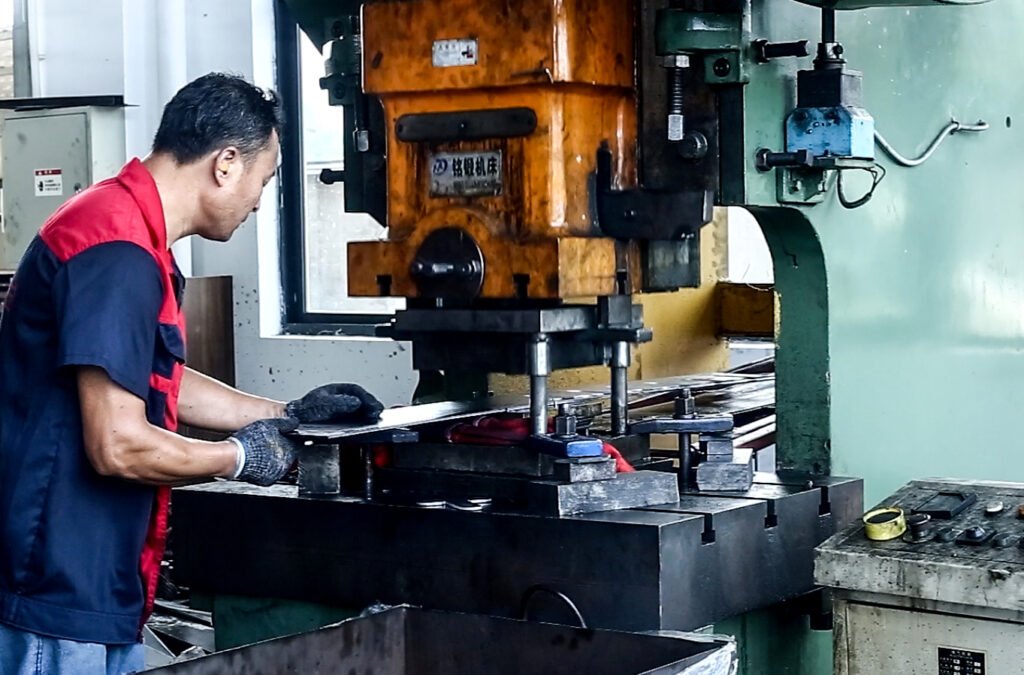
Pre-recorded videos can be borrowed. Ask for a scheduled video walk-through showing: raw steel stock, stamping/welding lines, the finishing line (powder coat or PVD), and the packing area. Look for work-in-progress — a trading office cannot fake half-finished goods on a line.
Step 3: Check Load Ratings and the Safety Factor
The number that matters is not “heavy duty” but the published kilogram rating and whether a safety factor is stated. Standard residential doors weigh 80–120 lb; your hardware should be rated at least 1.5× your heaviest door. Jiansen publishes 150 kg (330 lb) per kit with a recommended 50% safety margin — the format a serious factory uses. If a supplier quotes only “strong” or “heavy duty” with no number, walk away.
Step 4: Verify Steel Grade and Finish Documentation
For stainless lines, require the grade (304 vs 316) plus a salt-spray test report; for carbon steel, require coating thickness and salt-spray hours for powder coat. Ask for a material test certificate on a recent batch, not a generic brochure page.
Step 5: Order Samples and Torture Them
Order 1-set samples (Jiansen offers sample orders from 1 set) and test: roller smoothness after 500 cycles, track straightness with a level, weld penetration at hanger joints, and finish adhesion with a cross-cut test. Ball-bearing rollers should stay silent; bushing rollers squeak by cycle 200.
Step 6: Collect the Certification Package
File before purchase: ISO 9001 certificate, RoHS declaration, SGS/CE/EN71 test reports where relevant, and patent certificates if the supplier claims proprietary engineering (Jiansen lists 8 granted utility model patents on anti-swing and track systems). Verify certificate numbers with the issuing bodies where practical.
Step 7: Lock QC, Warranty and Communication in Writing
Confirm: staged inspections (raw material / mid-production / pre-shipment), third-party inspection acceptance, defect-rate policy, spare-parts ratio per container (1–2% is common), and response-time commitment. A supplier that answers these in writing within 48 hours is operationally mature; one that hesitates will hide problems at claim time.
Red Flags That End the Evaluation
- No kilogram load rating, only marketing adjectives
- Refusal of video tour or third-party inspection
- Samples shipped from a different company name than the contract
- No salt-spray or coating documentation for outdoor SKUs
- Payment to a personal account, not the company account
FAQ
What load rating is safe for wholesale residential doors?
Stock kits rated 150 kg (330 lb) and apply the 1.5× rule: hardware rating should be at least 1.5× the door weight.
How do I tell a factory from a trading company quickly?
Registered address in an industrial zone + manufacturing scope on the license + work-in-progress visible on a live video tour.
Which certifications matter for the U.S. market?
ISO 9001 for the quality system, RoHS for materials, and SGS/CE test reports for product claims; keep them on file per SKU.
Should I accept a supplier without patents?
Patents are not mandatory, but proprietary engineering (anti-swing devices, self-cleaning tracks) signals real R&D rather than copied tooling.
What sample tests catch most quality problems?
500-cycle roller noise test, track straightness, weld inspection at hangers, and a cross-cut adhesion test on the finish.
What spare-parts ratio should a container include?
1–2% free spares (rollers, bolts, guides) is standard practice among experienced exporters.
Sources
- Jiansen Hardware company profile (factory facts, ISO 9001, patents) — hzjiansen.com/about-us/
- Jiansen wholesale terms (load ratings, samples, lead time) — hzjiansen.com/faq/
- Jiansen product range — hzjiansen.com/products/
