
Direct answer
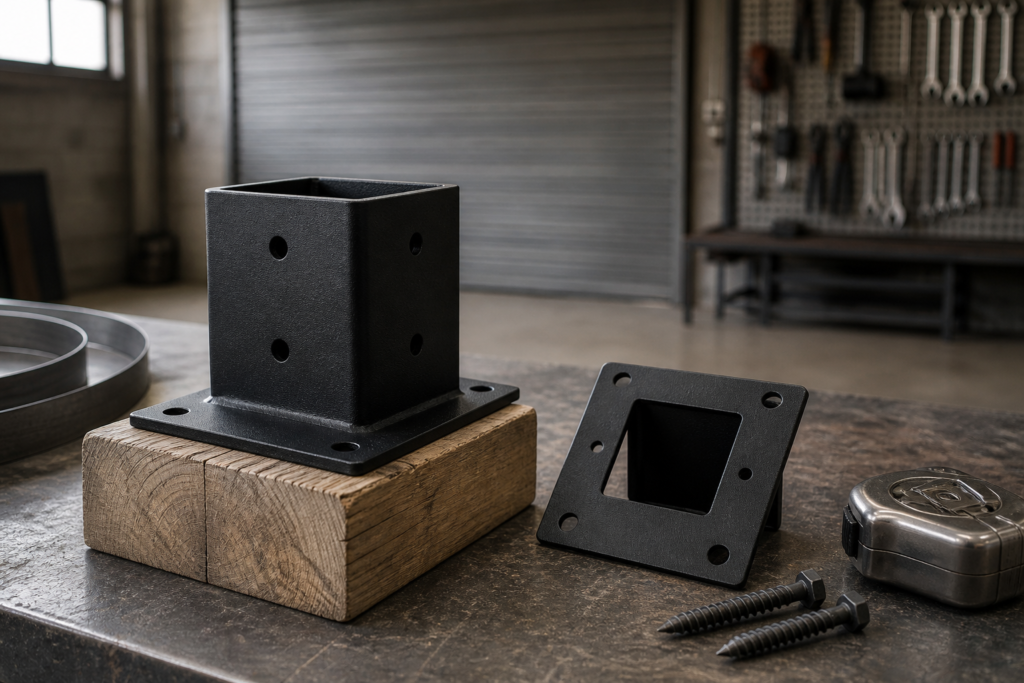
“Heavy duty” is not a rating. For pergola brackets it should mean four measurable things: steel thickness of 3 mm (0.118″) or greater, an inner opening matched to your actual timber cross-section within 2–3 mm, a fastener pattern that allows lag screws to reach at least 4× their diameter of penetration per the National Design Specification for Wood Construction (NDS 2015, §12.1.4.6), and a coating system rated for your climate.
If a supplier cannot give you all four numbers, “heavy duty” is marketing copy, not a specification.
This guide covers how to specify each one when sourcing pergola brackets at wholesale, and why the single most common failure in imported bracket orders has nothing to do with steel strength. If you are new to pergola hardware, the guide to metal pergola brackets explains the connector families before you compare load ratings.
Why most bracket returns are dimensional, not structural
In our own order history the most frequent complaint on pergola hardware is not a bent bracket. It is a bracket that does not fit the timber.
The reason is that nominal lumber sizes and actual lumber sizes are different numbers, and the gap is larger than most buyers expect:
| Nominal size | Actual surfaced (S4S) size | Metric equivalent |
|---|---|---|
| 4×4 | 3-1/2″ × 3-1/2″ | 88.9 mm |
| 6×6 | 5-1/2″ × 5-1/2″ | 139.7 mm |
| 2× (beam stock) | 1-1/2″ thick | 38.1 mm |
A bracket advertised as “fits 6×6” can mean an inner opening anywhere from 140 mm to 153 mm depending on which market the tooling was designed for. At 153 mm against a 139.7 mm post, you have 13.3 mm of total slack — 6.65 mm per side. The post will rock inside the socket regardless of how thick the steel is.
Specification rule: ask for the inner opening in millimetres, and state your timber’s actual cross-section, not its nominal name. A well-matched socket leaves 2–3 mm total clearance — enough for assembly tolerance and coating thickness, tight enough to prevent movement.
Our own standard openings are engineered around metric timber and imperial equivalents:
| Inner opening | Ideal timber | Total clearance |
|---|---|---|
| 92 × 92 mm (3.62″) | 90 × 90 mm metric, or nominal 4×4 (88.9 mm) | 2.0 mm / 3.1 mm |
| 153 × 153 mm (6.02″) | 150 × 150 mm metric | 3.0 mm |
| 143 × 143 mm (made to order) | nominal 6×6 (139.7 mm) | 3.3 mm |
| 47 mm beam socket (1.85″) | 45 mm metric beam | 2.0 mm |
Note the 143 mm entry. Because our brackets are laser cut rather than die stamped, a matched opening for US surfaced 6×6 is a made-to-order dimension rather than a new tooling project — which is why we quote it from 50 pieces with no tooling charge.
What steel thickness actually buys you
Thickness is the one “heavy duty” claim that is easy to verify and hard to fake.
| Thickness | Imperial | Typical use |
|---|---|---|
| 2.0 mm | 0.079″ | Light decorative frames, low-load joinery |
| 2.3 mm | 0.091″ | Light-duty connectors, small spans |
| 3.0 mm | 0.118″ (≈1/8″) | Standard for structural pergola connectors |
3 mm is the threshold we treat as the baseline for load-bearing pergola connections, and it aligns with the 1/8″ plate thickness used by established US pergola bracket brands. Below 3 mm you are buying a bracket that holds alignment but contributes little stiffness to the joint.
Two thickness questions worth asking any supplier:
- Is the stated thickness before or after coating? Powder coating adds 60–100 µm per surface. A “3 mm” bracket measured over the coating is a 2.85 mm bracket.
- Is the thickness uniform across the part? Deep-drawn or heavily formed corners can thin at the bend radius. Laser-cut-and-welded construction keeps the section constant.
Material grade matters alongside thickness. Q235 carbon steel with powder coating is the volume choice for most outdoor pergola work. SS304 stainless is specified for coastal installations, chlorinated pool environments, and any project where the client will not accept touch-up maintenance.
How to size fasteners: the 4D rule
This is where most spec sheets go quiet, and it is the part a structural reviewer will actually check.
Per NDS 2015 §12.1.4.6, the minimum penetration of a lag screw into the main member — excluding the tapered tip — is 4D, where D is the screw diameter. For a 1/2″ lag screw that is 2″ of thread in the post.
There is a second clause that matters even more for load capacity. When penetration falls between 4D and 8D, the reference lateral design value Z must be multiplied by a penetration factor of p / 8D. In plain terms:
- 1/2″ lag at 2″ penetration (4D) → roughly 50% of full lateral design value
- 1/2″ lag at 4″ penetration (8D) → 100% of the tabulated value
So a bracket with short screw holes, or a screw kit chosen for convenience, can cut the connection’s design capacity in half without anything looking wrong at installation.
What to ask for when sourcing:
- Screw diameter and length supplied in the kit (not just “hex screws included”)
- Number of fasteners per bracket, and whether the hole pattern spreads them across the grain
- For post bases: expansion bolt size and the concrete embedment depth assumed
For reference, our LTZJ series ships with a defined count per model rather than a generic bag — from 3 screws on a simple beam hanger to 64 on the five-way cross connector, plus 4 expansion bolts on every post base. When a supplier cannot tell you the count per SKU, they are not controlling the connection design.
Span and spacing: why brackets don’t set your limits
A common buyer question is “what span can these brackets carry?” It is the wrong question, and answering it with a single number would be misleading.
Pergola capacity is governed by the timber member, the span, the rafter spacing, the species and grade of the lumber, and the local snow and wind load — not by the connector in isolation. The connector’s job is to transfer load without slipping or splitting the wood.
The authoritative route is to size the structure first, then match the hardware:
- Determine your design loads. Rafter span tables are published per load combination — the Southern Forest Products Association alone publishes 46 tables covering live loads from 20 to 100 psf and deflection limits of L/180, L/240 and L/360.
- Pick beam and rafter dimensions from a code-recognised table. AWC’s Span Tables for Joists and Rafters is the referenced standard in most US jurisdictions.
- Confirm rafter spacing. 12″, 16″ and 24″ on-centre are the standard increments, and dropping from 24″ to 16″ is often cheaper than upsizing every rafter.
- Then select the bracket family that matches the timber cross-section you arrived at.
Two practical notes for buyers importing into snow regions: span tables for snow load apply a load duration factor of CD = 1.15, and construction-load tables use 1.25. If your customer base is in a snow-load state, specify to the snow table, not the general one.
For distributors, the useful takeaway is that hardware selection is downstream of structural design. That is why we supply CAD and Pro-E drawings for every model in the pergola bracket range — the drawing is what your customer’s engineer or building department actually needs, and 3D files can be sent straight to a 3D printer for fit checks before a container ships.
A specification checklist for wholesale orders
Use this when comparing quotes. Any supplier who can fill in every row is quoting a real product.
| # | Specification | What to require |
|---|---|---|
| 1 | Inner opening (mm) | Matched to actual timber cross-section, 2–3 mm total clearance |
| 2 | Steel thickness | 3 mm minimum for structural connections; confirm pre- or post-coating |
| 3 | Material grade | Q235 carbon steel or SS304 stainless, stated explicitly |
| 4 | Coating system | Powder coat colour, film thickness in µm, adhesion test on request |
| 5 | Fastener kit | Screw diameter, length, count per bracket; expansion bolts for bases |
| 6 | Penetration check | Screw length allows ≥4D into main member; 8D for full design value |
| 7 | Drawings | 2D dimensioned drawing + 3D file for engineering review |
| 8 | Packaging | Pieces per box, gross weight, carton dimensions for freight calculation |
| 9 | Quality system | ISO 9001 certificate number, verifiable on the registrar’s site |
| 10 | Test reports | Salt spray / adhesion / load reports — or lead time to produce them |
On row 10, be direct with suppliers about what exists today versus what can be arranged. A factory that says “we can run ASTM B117 salt spray and load testing on your SKU within two weeks” is more useful than one that emails a certificate for a different product line. Before you reach the quote stage at all, our article on how to verify a Chinese hardware supplier covers the licence checks and factory audits that belong upstream.
Frequently asked questions
What does “heavy duty” mean for a pergola bracket?
There is no certification behind the phrase. Treat it as four verifiable specs: steel thickness of 3 mm (0.118″) or more, inner opening matched within 2–3 mm of your actual timber, a fastener pattern permitting at least 4× diameter of lag screw penetration per NDS 2015 §12.1.4.6, and a coating rated for the install climate. Ask for all four in writing.
Will a 6×6 pergola bracket fit my 6×6 post?
Not necessarily. Surfaced nominal 6×6 lumber is actually 5-1/2″ (139.7 mm), while some brackets are built with a 153 mm opening for metric 150 × 150 mm timber. That combination leaves 13.3 mm of slack. Always confirm the inner opening in millimetres against your timber’s actual measured cross-section, and request a matched opening — for surfaced 6×6 that is about 143 mm.
How deep do lag screws need to go into the post?
NDS 2015 §12.1.4.6 sets minimum penetration at 4× the screw diameter, excluding the tapered tip — 2″ for a 1/2″ lag screw. But between 4D and 8D the lateral design value is reduced by a factor of p/8D, so 2″ of penetration yields roughly half the capacity of 4″. Specify screw length for the penetration you need, not the minimum.
What load can heavy duty pergola brackets carry?
No single figure applies, and a supplier quoting one without a test report or engineering basis should be questioned. Capacity depends on timber species and grade, member size, span, rafter spacing, fastener penetration, and local snow and wind loads. Size the structure from a code-recognised span table first — AWC’s Span Tables for Joists and Rafters, or the SFPA tables for Southern Pine — then match hardware to the resulting timber dimensions.
Should I specify carbon steel or stainless steel?
Powder-coated Q235 carbon steel is the volume choice and suits most inland residential and commercial pergolas. Specify SS304 stainless for coastal sites, pool and spa surrounds, and any project where the end client will not perform coating maintenance. Stainless carries a material cost premium, so it is usually applied selectively rather than across a whole programme.
What is a realistic MOQ for custom bracket dimensions?
It depends on the tooling method. Die-stamped parts require a new die for a new opening size, which pushes minimums into the thousands plus tooling cost. Laser-cut construction changes the cut file instead — our custom inner dimensions start at 50 pieces with no tooling fee, which is what makes market-specific opening sizes practical for smaller programmes.
How many fasteners should come with each bracket?
It varies by geometry, and the count should be stated per SKU rather than as a generic kit. A simple beam hanger may take 3 screws; a five-way cross connector needs 64; post bases add 4 expansion bolts each. If a quotation lists “screws included” without counts, ask for the per-model breakdown before comparing prices.
Summary
Specifying heavy duty pergola brackets comes down to replacing adjectives with numbers. Confirm the inner opening in millimetres against your timber’s actual cross-section. Require 3 mm steel minimum and clarify whether that measurement includes coating. Size lag screws for the penetration you need, remembering the p/8D reduction between 4D and 8D. Size the structure from a published span table before selecting hardware, not after.
Jiansen has manufactured architectural and building hardware since 2004 and holds ISO 9001:2015 certification (certificate 30226Q00395R201, valid to July 2029) covering production and sales of hardware components. For pergola bracket programmes we supply dimensioned drawings for every model, custom inner openings from 50 pieces, and product-specific test reports on request.
Sources
- American Wood Council — National Design Specification (NDS) for Wood Construction, lag screw penetration provisions, §12.1.4.6 — awc.org/publications
- Engineering Express — Minimum penetration for lag screws in wood (NDS 4D rule and p/8D penetration factor) — engineeringexpress.com
- Southern Forest Products Association — Southern Pine Joists & Rafters span tables (46 tables, load and deflection combinations) — southernpine.com
- American Wood Council — Span Tables for Joists and Rafters — awc.org
- American Wood Council — Connection Calculator (single bolts, lag screws, wood screws per NDS) — awc.org
