
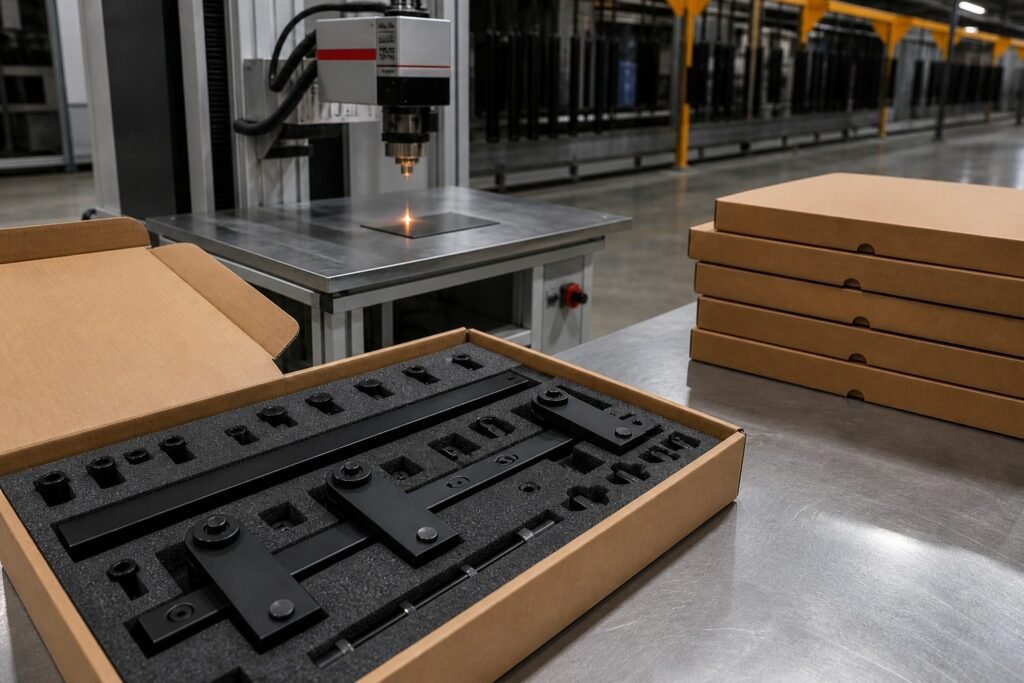
Short answer: OEM (your design, factory-produced) and ODM (factory design, your brand) are the two routes importers use to build a private-label barn door hardware line. ODM is the faster, lower-risk start — you select from a manufacturer’s proven platform (track profile, roller design, load-rated components), add your logo, finish color, and packaging, and launch in 30–45 days. OEM becomes worthwhile when you need a differentiated design or exclusive tooling, typically at 1,000+ kit commitments. The five checks that separate good OEM/ODM partners from risky ones: published load ratings with safety margins, documented QC checkpoints, material certificates, sample approval gates, and a written mold/tooling ownership clause.
OEM vs ODM vs Ready-Made: Which Route Fits Your Business?
| Route | Who owns the design | Typical MOQ | Time to first shipment | Best for |
|---|---|---|---|---|
| Ready-made (catalog) | Factory | 1 set (sample) | 7–15 days | Testing the market, small retailers |
| ODM (private label) | Factory platform + your brand | 200–500 kits | 30–45 days | Distributors building a brand line |
| OEM (custom design) | You | 1,000+ kits | 60–120 days incl. tooling | Established brands needing exclusivity |
Most importers should start with ODM. A manufacturer’s existing platform has already absorbed the engineering risk — track straightness tolerances, roller bearing selection, and load testing are proven at volume. You customize the commercially visible layer: powder-coat color, logo engraving or print, packaging, and documentation. The result is a sellable private label without tooling investment.
Move to OEM when one of three conditions applies: your target spec does not exist in any factory catalog (a unique track profile or soft-close mechanism), you need design exclusivity with registered appearance protection, or your channel demands it (large retail chains often require exclusive SKU numbers and unique packaging).
What Can Be Customized on a Barn Door Hardware Kit
Understanding the customization menu helps you price requests accurately:
- Finish and color. Powder coating in any RAL color is standard on carbon steel — matte black remains the volume leader, with brushed gold and gunmetal as the growth colors. Stainless steel lines offer brushed or mirror finishing, with PVD color as a premium add-on.
- Logo and branding. Laser engraving on door stops and hangers (common on stainless), printed or embossed logos on track caps, and branded roller covers. Laser engraving usually carries no extra mold cost; embossed logos require a small stamping die.
- Packaging. Retail-ready color boxes with your design, EAN/UPC labeling, foam or molded-pulp inserts for damage protection, and printed installation manuals in your language. Packaging customization is where most private-label cost variance happens — a printed color box typically adds $0.80–2.00 per kit depending on quantity and print colors.
- Component configuration. Adding or substituting accessories: floor guide types, soft-close dampers, anti-jump blocks, handle sets. Mixing components from one catalog into a unique SKU combination is standard ODM practice.
- Documentation and certification support. Test reports (SGS or equivalent), RoHS documentation, and mill certificates for stainless grades — required by Amazon, major retail chains, and EU importers.
The OEM/ODM Order Process Step by Step
A disciplined sequence protects both money and schedule:
- Inquiry with spec sheet. Send target kit contents, door weight/thickness ranges, finish, and estimated annual volume. A complete spec sheet gets an accurate quote in 24–48 hours; vague inquiries get wide price ranges.
- Quotation with breakdown. Require separate lines for unit price, packaging, tooling/mold fees (if any), and certification costs. This makes future reorders and design changes auditable.
- Sample order. Order 1–3 sets. Factories with wholesale-first processes ship samples within 7–15 days. Evaluate the sample with a teardown: check weld quality at track joints, roller bearing smoothness, finish thickness (a simple mil gauge catches thin powder coat), and screw/anchor completeness.
- Sample approval and deposit. Sign off a written sample approval that references photos of the exact approved unit. Production disputes almost always trace back to missing or verbal approvals.
- Production (15–30 days). A 20–45 day container-load program follows the same timeline as catalog goods; OEM tooling adds 20–40 days before production starts.
- Pre-shipment QC. Inspect against the approved sample: dimensional checks on track length and hole spacing, finish adhesion (cross-cut test), and load testing on a sample kit at the rated weight plus the safety margin. Third-party inspection (SGS/BV) costs a few hundred dollars and is standard for container orders.
- Shipment and after-sales. Agree on defective-goods handling in the PO: reputable factories reserve 1–2% spare parts in the container and define a replacement or credit process for QC failures.
Tooling, MOQs and Costs: What to Budget
- ODM private label: usually zero tooling cost. MOQs commonly run 200–500 kits per SKU, with sample orders from 1 set. Budget focus shifts to packaging artwork (one-time design cost) and certification reports.
- OEM with new tooling: expect $500–3,000 per mold depending on part complexity (a roller housing mold costs far less than a full track extrusion die), plus a 1,000+ kit MOQ to amortize it. Insist on a tooling ownership clause: if you pay for the mold, the contract should state it belongs to you and moves with you.
- Hidden cost watch items: finish color changes mid-program (requires new powder setup), retail packaging changes after artwork approval (reprint charges), and certification re-testing after design changes.
Jiansen’s published structure is representative of a wholesale-first factory: sample orders from 1 set, production lead time 15–30 days (30–45 for container volume), published load ratings of 150 kg (330 lb) per kit with a 50% safety margin, and a certification package covering ISO 9001, RoHS, SGS and CE — the documentation retail channels demand. Full order-term detail for first purchases is covered in our MOQ, lead time and shipping guide.
How to Verify an OEM/ODM Manufacturer Before Committing
- Factory audit trail. Ask for the ISO 9001 certificate number and verify it with the issuing body; check factory photos/video of the track rolling and powder-coating lines, not just assembly benches.
- Published ratings vs “heavy duty” claims. A manufacturer that publishes kilogram load ratings with a stated safety margin is engineering its product; one that only says “heavy duty” is marketing it.
- QC checkpoint documentation. Ask which checkpoints exist between raw steel and packing (incoming material check, in-process dimensional inspection, finish thickness check, final load test). Vague answers here predict quality variance.
- Reference customers. Ask which markets the factory ships to and whether any distributor has run the same SKU for 2+ years. Long-running SKUs indicate stable processes.
- Communication depth. Test with a technical question — e.g., “What roller bearing spec do you use for the 150 kg rating?” Factories that engineer their kits answer with part-level detail.
The full supplier verification workflow — documentation requests, red flags, and sample evaluation — is in our guide to verifying a Chinese barn door hardware supplier.
Jiansen runs OEM/ODM programs across both the carbon steel barn door hardware line and the stainless steel line from its 26,000 m² facility, with mixed-material containers and matched branding under one PO — and the complete barn door hardware kit catalog available as the ODM starting point.
Frequently Asked Questions
What is the difference between OEM and ODM barn door hardware?
OEM means you provide the design and the factory manufactures it; ODM means the factory provides a proven design that you brand and customize. ODM is faster and cheaper to launch (30–45 days, no tooling); OEM gives design exclusivity but requires tooling investment and higher MOQs.
What is a typical MOQ for private-label barn door hardware?
200–500 kits per SKU is the common ODM range, with sample orders available from 1 set. OEM projects with new tooling typically start at 1,000+ kits to amortize mold costs of $500–3,000.
How long does an OEM/ODM barn door hardware order take?
ODM private label: 30–45 days to shipment including packaging. OEM: add 20–40 days upfront for tooling, making 60–120 days total. Standard production itself runs 15–30 days (30–45 for container volume).
Can I get my logo on existing hardware designs?
Yes. Laser engraving on metal parts and printed or embossed logos on track caps and packaging are standard ODM services. Engraving carries no mold cost; embossed logos require a small stamping die.
What certifications should I request for retail channels?
ISO 9001 (quality system), RoHS, and product test reports (SGS or equivalent) cover Amazon and most retail chains; EU importers also need CE documentation. Request these before ordering — factories that already hold them include them in the quotation.
Who owns the molds if I pay for OEM tooling?
The contract should state explicitly that you own the tooling you pay for, and that it can be transferred if you change suppliers. Without this clause, factories commonly retain molds by default — negotiate it during the quotation stage, not after payment.
