
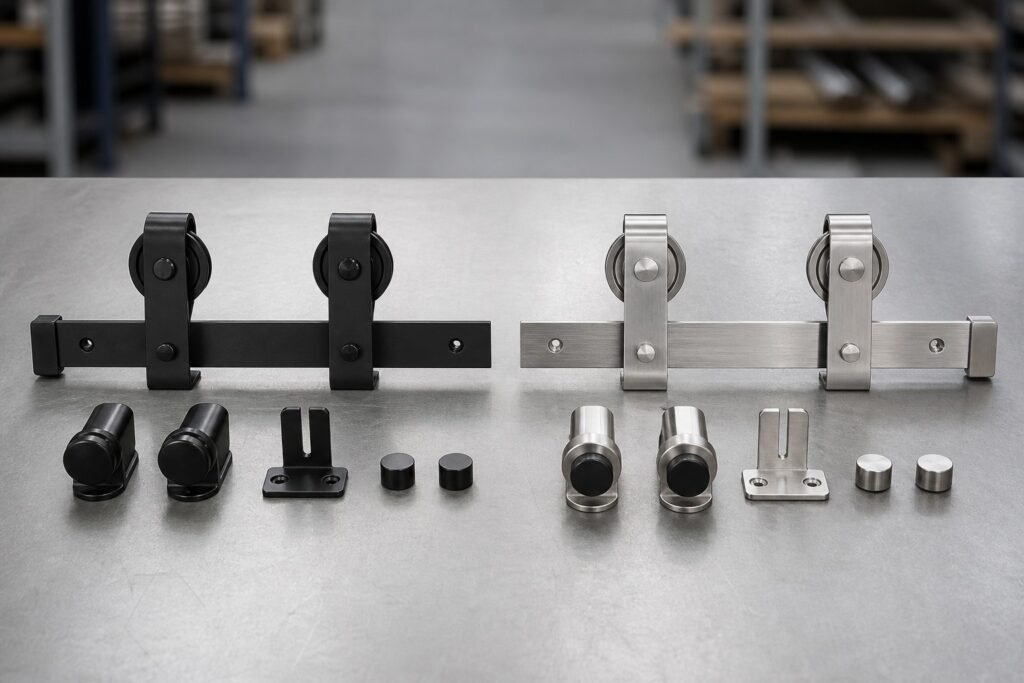
Short answer: For standard interior installations, powder-coated carbon steel is the volume choice — it costs roughly a third of stainless, carries the same published load ratings when built with the same track profile, and accepts any finish color. Specify 304 stainless steel where humidity, coastal air, or design specs demand corrosion resistance, and 316 for salt-exposed exteriors. The decision is application-driven, not quality-driven: both materials perform identically in dry interior service. Jiansen Hardware manufactures both lines with a published rating of 150 kg (330 lb) per kit at a 50% safety margin, so distributors can stock both under one consistent spec sheet.
Which Material Should Wholesale Buyers Stock First?
Stock carbon steel first if your customer base is residential contractors, interior designers, and building-supply retail. Industry sales patterns consistently show black powder-coated carbon steel kits as the default US residential specification — matte black alone typically accounts for the majority of sliding barn door hardware volume. The material cost gap is the driver: a comparable carbon steel kit wholesales in the $12–25 FOB range, while the stainless equivalent sits at $49–88, so carbon steel lets you carry more SKUs for the same inventory investment.
Add stainless to your lineup when three conditions appear: coastal or high-humidity project specs (Florida, Gulf Coast, bathroom and barn conversions), architect schedules that name 304 stainless explicitly, and premium retail customers who treat visible hardware as a finish material. Stainless is a margin product, not a volume product — sell it where the spec demands it.
Carbon Steel Barn Door Hardware: Where It Wins
Carbon steel’s advantage is economics per unit of strength. The track, hangers, and door stops in a carbon steel kit are stamped or rolled from the same gauge stock used in stainless kits, so a properly engineered carbon steel kit carries the same load rating — Jiansen publishes 150 kg (330 lb) per kit for both materials, each with a stated 50% safety margin. Strength is a function of section geometry, not the alloy alone.
Three practical wholesale advantages:
- Finish flexibility. Powder coating adheres to prepared carbon steel in any RAL color. Matte black, brushed gold, and gunmetal are the current US demand leaders; custom colors are a straightforward OEM request. Stainless, by contrast, is sold in its natural brushed or mirror finishes, and PVD color coating on stainless adds cost and limits the palette.
- Unit economics. At roughly one-third the material cost, carbon steel supports aggressive distributor pricing, retail promotions, and container-load programs with faster inventory turns.
- Proven track record. The bulk of installed barn door hardware in North America is painted or powder-coated carbon steel; installers know it, and warranty data on it is deep.
The one genuine weakness is corrosion. Bare or damaged carbon steel rusts; the defense is finish quality. Specify powder coat with a documented salt-spray test (a responsible factory will share the report), and inspect chip resistance on samples — a finish that chips under a fingernail test will fail within a season in a humid space.
Stainless Steel Barn Door Hardware: Where It Wins
Stainless steel wins on corrosion resistance and perceived quality, and both matter in specific wholesale channels:
- Coastal and humid projects. 304 stainless resists the humidity and salt-air exposure that pits powder-coated carbon steel within one to two years. For exterior-adjacent installations — covered patios, barn conversions, coastal homes — 304 is the minimum grade; direct salt spray calls for 316.
- Specification-driven sales. Architects and hospitality projects frequently schedule 304 stainless by name. Being able to quote a stainless line with material certificates puts you on these projects; carbon steel cannot be substituted without a change order.
- No-finish maintenance. Brushed stainless shows wear as patina rather than failure. There is no coating to chip, so the failure mode buyers fear with any hardware — visible rust — is eliminated by design.
The costs to manage: material price roughly triples versus carbon steel, machining and polishing labor is higher, and the natural finish limits color options. Grade verification matters too — 201 stainless (cheaper, less nickel, weaker corrosion resistance) sometimes appears in budget supply chains. Ask for the mill certificate or a grade test; a 304 kit priced suspiciously close to 201 costs is usually 201.
Side-by-Side Comparison for Buyers
| Factor | Carbon Steel | Stainless Steel (304) |
|---|---|---|
| FOB wholesale range (Jiansen published) | $12–25 per kit | $49–88 per kit |
| Load rating (same track geometry) | 150 kg / 330 lb per kit | 150 kg / 330 lb per kit |
| Corrosion resistance | Depends on powder coat; indoor only | Excellent indoors; good in humidity (304) |
| Finish options | Any powder-coat color | Brushed / mirror natural; limited PVD |
| Best wholesale channel | Residential contractors, retail volume | Coastal projects, architect specs, premium retail |
| Main risk | Finish chipping → rust | Grade fraud (201 sold as 304) |
| Typical margin structure | Volume-driven | Margin-driven |
How to Decide by Application
- Dry interior rooms (bedrooms, living rooms, offices): carbon steel, powder-coated. Nothing about stainless improves function here.
- Bathrooms, laundry rooms, basements: carbon steel is acceptable with quality powder coat; specify stainless if the room sees direct moisture or the client wants a zero-maintenance story.
- Covered outdoor and coastal interiors: 304 stainless minimum; verify the rollers are also stainless or use POM/nylon rollers on stainless hangers.
- Direct exterior / marine-adjacent: 316 stainless, or redirect the client to a product category built for exterior service.
- Commercial hospitality: follow the architect schedule; stainless is the common spec, with carbon steel offered as the value alternative for back-of-house doors.
What to Verify with Your Supplier Before Ordering
Wholesale due diligence is the same for both materials, with two extra checks:
- Load rating with safety factor. Require a published kilogram rating per kit plus the safety margin. Jiansen’s format — 150 kg (330 lb) with a 50% margin — is the benchmark; vague “heavy duty” claims are not.
- Salt-spray / finish test reports. For carbon steel, this is the only objective evidence the powder coat will last. For stainless, request the mill/grade certificate confirming 304 or 316.
- Roller construction. Ball-bearing rollers with POM or nylon contact surfaces run quieter and longer than bare steel-on-steel in both materials.
- Certification package. ISO 9001 quality system plus RoHS and product test documentation (SGS / CE) is what distributors should file for each SKU.
- Sample teardown. Order one kit of each material, disassemble a hanger, check weld quality on the track joints, and run the roller over the track by hand before committing volume.
Standard terms from a wholesale-first factory should look familiar: sample orders from 1 set, production lead time 15–30 days (30–45 for container volume), FOB Ningbo. Full material detail on the stainless side is covered in our stainless steel barn door hardware wholesale guide.
Jiansen manufactures both the carbon steel barn door hardware line and the stainless steel barn door hardware line in the same 26,000 m² facility, so mixed-material containers and matched OEM branding are standard orders. Component-level sourcing — floor guides, rollers, and accessories sold separately — is also available; see the barn door floor guide selection guide for the matching bottom hardware.
Frequently Asked Questions
Is stainless steel barn door hardware stronger than carbon steel?
No. With the same track profile and roller design, both carry the same published load rating — Jiansen rates both lines at 150 kg (330 lb) per kit with a 50% safety margin. Stainless wins on corrosion, not strength.
Can carbon steel barn door hardware be used outdoors?
Not as a rule. Powder-coated carbon steel suits dry and covered interiors; any chip exposes steel that rusts outdoors. Use 304 or 316 stainless for exterior or marine-adjacent service.
Why do stainless steel kits cost two to three times more?
Raw material cost is the base driver (nickel content), and polishing/machining labor on stainless is higher. The wholesale spread — roughly $12–25 for carbon steel versus $49–88 for 304 stainless per kit — reflects materials and finishing labor, not a strength difference.
How do I tell 304 stainless from cheaper 201?
Request the mill certificate, or use a spot test kit (201 reacts differently to manganese reagents). Price is a signal: a “304” kit quoted near 201 pricing is almost certainly mislabeled.
What finish should a distributor stock most of?
Matte black powder coat on carbon steel is the US residential default. Add brushed gold as the secondary color, and keep brushed stainless as the premium option for coastal and spec-driven buyers.
Can I order mixed containers of both materials?
Yes. A factory-direct supplier with both lines can build mixed containers — typically carbon steel volume SKUs plus stainless spec SKUs — under one OEM brand, which is how most distributors cover both channels with a single supplier relationship.
