
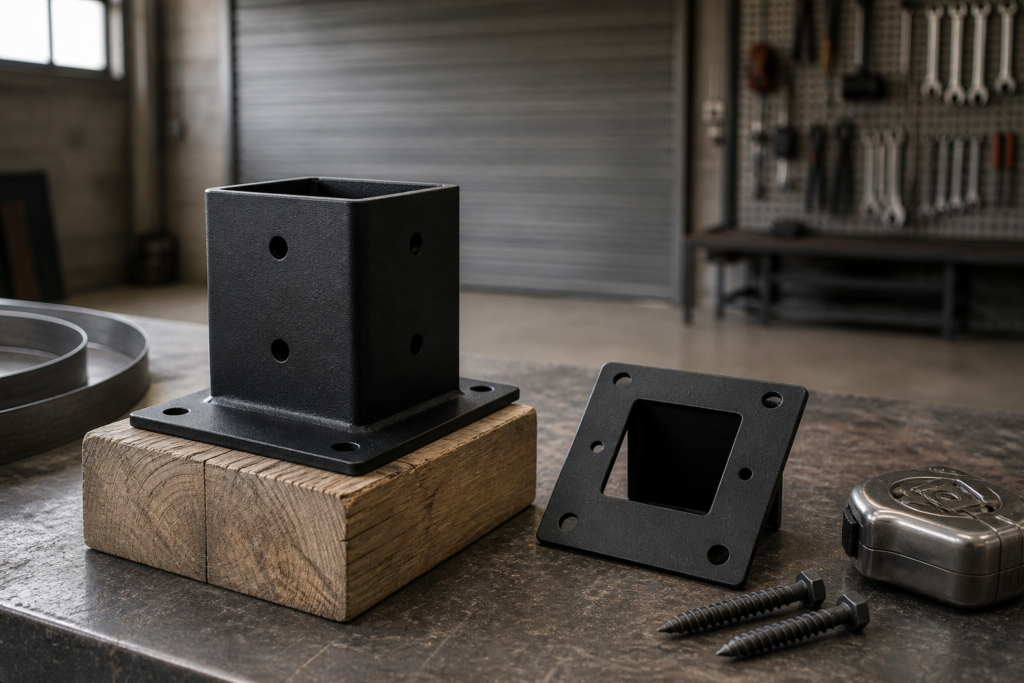
Direct answer: wall-mounted and freestanding pergola connectors should not be sourced from the same uncontrolled specification. A wall-mounted assembly transfers part of the structure’s demand into an existing building, so the buyer must define the interface, substrate, flashing, fasteners, clearances, and local design approval. A freestanding assembly carries loads through its own posts, beams, joints, bases, and foundations, so the RFQ must control every connector position and the complete load path. In both cases, the connector supplier should manufacture to buyer-approved drawings rather than choose structural requirements for the project.
This guide is for importers, wholesalers, pergola-kit brands, project buyers, fabricators, and OEM teams. It explains how to compare the two connector systems, prepare one auditable RFQ, approve samples, and inspect production. It does not assign universal spans, load ratings, anchor sizes, coating life, prices, or minimum order quantities. Those values depend on the complete structure, site conditions, substrate, exposure, applicable codes, and a qualified designer’s approval.
Which Pergola Connector System Fits the Project?
| Decision area | Wall-mounted pergola | Freestanding pergola |
|---|---|---|
| Primary interface | Existing wall or building structure plus outer posts | Posts, beams, joints, bases, and foundations within one independent frame |
| RFQ priority | Wall substrate, attachment zone, flashing, clearance, and approved anchors | Post and beam sizes, connector map, base conditions, squareness, and complete kit BOM |
| Supplier drawing set | Bracket drawings plus a controlled building-interface detail | Bracket drawings plus a numbered assembly and connector schedule |
| Major procurement risk | Treating cladding or sheathing as a structural substrate | Missing one connector orientation or mixing parts between frame positions |
| Packaging priority | Separate wall-interface hardware and installation documents | Zone-based kits for posts, corners, beams, bases, and braces |
The table is a procurement framework, not an engineering design. For an example of why attachment to an existing structure needs explicit control, the American Wood Council explains that a ledger connection should be positively connected to the building structure rather than rely on nail-only attachment. A pergola is not automatically a deck, and the referenced details must not be copied into a pergola drawing without project-specific review. The useful sourcing lesson is narrower: identify the real supporting structure, define the interface, and require approved connection details before manufacturing.
How Should Buyers Specify Wall-Mounted Pergola Connectors?
1. Define the building interface before the bracket
The RFQ should identify the supporting structure behind the exterior finish. Record the substrate description, attachment zone, stand-off distance, cladding and insulation layers, expected drainage path, and areas where penetrations are prohibited. Do not ask the connector factory to infer these facts from a façade photograph.
2. Issue a controlled connection drawing
The drawing should show bracket geometry, hole positions, edge distances, mating timber or metal profiles, required clearances, weld symbols where applicable, and the buyer-approved fastener or anchor reference. Mark critical characteristics separately from reference dimensions. If the designer changes the substrate or anchor plan, issue a new drawing revision instead of changing instructions in chat.
3. Separate weather management from structural attachment
Flashing, sealant, drainage gaps, isolation materials, and corrosion couples need their own fields in the specification. A structurally acceptable bracket can still create leakage or trapped moisture if the interface is not coordinated. The connector supplier can verify manufactured dimensions and finish, but the project team remains responsible for the wall assembly and installation method.
How Should Buyers Specify Freestanding Pergola Connectors?
1. Create a connector map for the complete frame
Number every post base, corner, beam support, splice, brace, and special orientation. Link each number to a drawing, quantity, finish code, and packaging zone. This prevents a quotation based on an incomplete photo set and gives the inspector a countable BOM.
2. Control timber or tube interfaces
Nominal size labels are not enough. State the buyer-approved actual mating dimensions, permitted gaps, insertion depth where relevant, hole pattern, orientation, and datum surfaces. When several profiles are used, define a fit gauge or approved mating sample for each interface.
3. Treat post bases and upper joints as different items
Post bases interact with foundations, moisture, drainage, anchors, and installation tolerances. Upper joints control beam alignment and connector orientation. Give them separate drawings, defect criteria, inspection records, and package labels rather than one generic “pergola bracket” specification.
Buyers can review Jiansen’s metal pergola bracket category to identify product families, but the category page is not a substitute for the project drawing set. For kit completeness, use the existing pergola bracket kit BOM checklist. For project-defined loading and span questions, see the separate heavy-duty pergola bracket specification guide.
What Must Be Included in a Pergola Connector RFQ?
Send the same package to every candidate supplier:
- project type: wall-mounted or freestanding;
- controlled assembly drawing and numbered connector map;
- individual part drawings with revision identifiers;
- material grade or buyer-approved equivalent process;
- sheet, plate, tube, or casting requirements;
- weld symbols, cosmetic zones, and workmanship criteria;
- finish system, color reference, gloss or texture target, and protected interfaces;
- mating profiles, fit gauges, or approved samples;
- BOM quantities and spare-part rules;
- packaging zones, labels, barcode fields, and document pouch requirements;
- inspection plan, defect classes, sample size, and acceptance rules;
- change-control rule: no substitution without written approval.
For acceptance sampling, buyers can locate the current edition of ISO 2859-1 through the ISO standards catalogue. The standard does not choose the buyer’s lot definition, inspection level, acceptance quality limit, or response to failure. Those decisions must be written into the purchase agreement.
How Should Samples Be Approved?
Approve a representative set, not one attractive bracket
The sample set should cover each connector family, orientation, material thickness group, finish, and interface that creates a distinct risk. Include the wall interface for a wall-mounted system, or the post base, corner, beam support, and brace interfaces for a freestanding system.
Record measurements and appearance separately
Create a dimensional report tied to drawing characteristics. Then approve a visual reference for color, texture, gloss, weld cleanup, edge condition, and cosmetic zones. A photograph alone cannot serve as a dimensional master; an unsigned drawing cannot define an acceptable appearance.
Freeze the production method after approval
Record material source, tooling, welding route, surface preparation, coating system, curing controls, and packaging method to the level required by the buyer’s risk plan. Any proposed change should trigger written review and, when necessary, renewed samples.
What Should the QC Checklist Verify?
Incoming and in-process controls
- material identity against the purchase specification;
- cut length, hole pattern, bends, datums, and interface dimensions;
- weld location and visible workmanship against approved criteria;
- sharp-edge and burr control;
- thread protection and gauge fit where threaded features are supplied;
- part orientation and connector-map identity.
Finish controls
Define the coating system and preparation process instead of ordering “outdoor powder coating” as a vague phrase. The inspection plan may include buyer-approved checks for film thickness, color, gloss, adhesion, coverage, cure, and corrosion performance. Use the current applicable methods agreed in the contract; the ASTM standards catalogue is one official source for locating relevant coating and materials standards.
Final kit and packaging controls
- compare every carton against the approved connector map and BOM;
- separate wall-interface hardware from general frame hardware;
- protect coated faces, edges, threads, and projecting features;
- prevent unlike parts from rubbing during transit;
- include drawing revision, part number, quantity, finish code, and package-zone label;
- verify installation documents match the shipped revision.
If barcodes are required, define the identifier, data carrier, placement, print quality, and verification method. The GS1 barcode standards explain common identification systems, but the buyer must specify which data structure applies to the distribution process.
How Should Buyers Audit Supplier Change Control?
Ask the factory to identify who approves drawing revisions, material substitutions, tooling repairs, welding-route changes, coating changes, subcontractor changes, and packaging changes. The purchase order should state that no controlled change is valid until the buyer approves it in writing. During an audit, select one recent change and trace it from request through sample, inspection record, approval, and released production documents.
FAQ: Pergola Connectors
Are wall-mounted and freestanding pergola connectors interchangeable?
No. They may share manufacturing processes, but they have different interfaces, connector maps, weather-management requirements, and project responsibilities. Use separate controlled drawings and approval records.
What is the first document to send a pergola connector supplier?
Send a controlled assembly drawing with the project type, numbered connector map, mating profiles, interface conditions, BOM, finish codes, and drawing revision.
Can a connector manufacturer choose the anchor for a wall-mounted pergola?
The project’s qualified designer or responsible buyer should approve the substrate and anchor design. The connector manufacturer should make and inspect the bracket to the approved interface drawing.
How should a freestanding pergola kit be packaged?
Package by installation zone, such as post bases, corners, beam supports, braces, and hardware. Label each zone with part numbers, quantities, finish codes, and the applicable drawing revision.
Which dimensions are critical for pergola connector QC?
Critical dimensions depend on the approved assembly, but commonly include mating-profile interfaces, hole locations, datums, clearances, insertion depths, and dimensions that control alignment or installation.
How should coating quality be specified?
Define surface preparation, coating system, color, texture or gloss target, protected areas, and buyer-approved inspection methods. Do not rely on the phrase “outdoor coating” alone.
When should a supplier re-submit samples?
Require renewed samples when a controlled change could affect fit, function, appearance, durability, packaging, or traceability, including changes to material, tooling, welding, coating, subcontractors, or critical dimensions.
Conclusion
A reliable pergola connector purchase starts by separating wall-mounted and freestanding systems. Control the load-path interfaces, drawings, BOM, finish, samples, inspection plan, packaging, and changes before comparing price or lead time. Jiansen can manufacture metal pergola connectors to buyer-approved drawings and inspection requirements; project engineering, structural approval, and local-code compliance remain with the responsible project team.
