
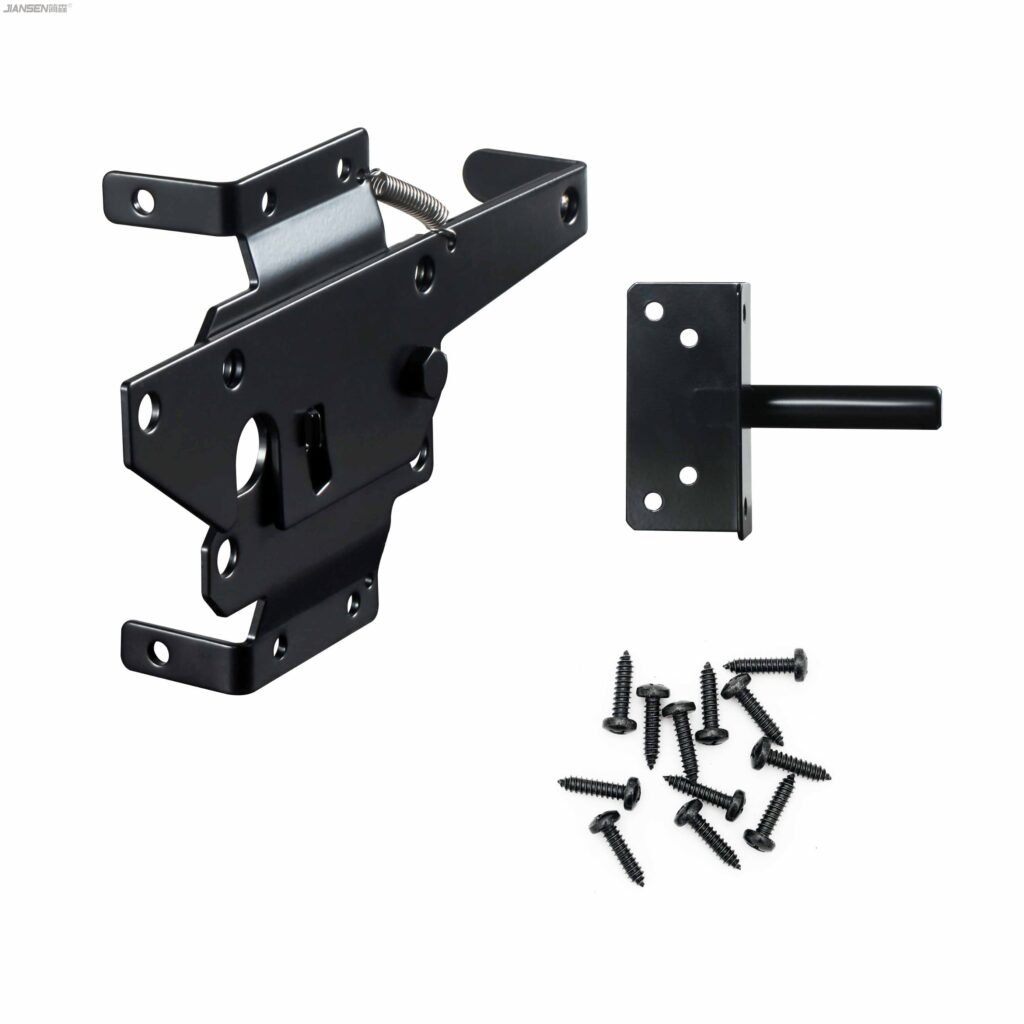
Direct answer: A qualified fence gate hardware supplier should be able to convert your application requirements into controlled drawings, a revision-controlled bill of materials, an approved sample, a documented production route, and a lot-specific inspection record. Buyers should audit this evidence before approving volume production, then verify each shipment against the same controlled baseline. A factory profile, catalogue, or verbal promise is not enough.
This guide is for importers, distributors, OEM brands, contractors, and procurement teams sourcing hinges, latches, drop rods, gate wheels, anti-sag kits, fasteners, or mixed hardware sets. It covers supplier qualification and production quality control rather than consumer installation. Use the workflow to compare suppliers on traceability, process discipline, and objective evidence.
What should buyers audit before selecting a fence gate hardware supplier?
Start with the supplier’s ability to control the exact configuration you intend to buy. The audit should connect five elements: the commercial order, engineering definition, manufacturing process, inspection plan, and shipment release. If one element changes without approval, the evidence chain is broken.
| Audit area | Evidence to request | Buyer decision |
|---|---|---|
| Scope and capability | Product family list, process map, equipment list, outsourced-process register | Can the factory control this specific hardware family and its critical processes? |
| Engineering control | Approved drawing, BOM, revision history, signed sample, deviation log | Is there one unambiguous specification baseline? |
| Material traceability | Material identification, lot records, purchase records, incoming inspection | Can finished goods be traced to declared inputs? |
| Process control | Work instructions, inspection points, gauge list, maintenance and training records | Are critical steps repeatable and recorded? |
| Final release | Sampling instruction, test records, defect log, packing check, release signature | Was this shipment accepted against buyer-approved criteria? |
ISO 9001 provides requirements for a quality management system, but a certificate alone does not prove that one order meets its drawing. Treat a valid quality-system certificate as supporting evidence and continue auditing the product-specific controls below.
How do you define the product before requesting quotations?
Prepare an RFQ package that lets competing suppliers quote the same requirement. Identify each part and set, intended gate material, mounting interface, operating environment, finish system, packaging, labels, spare parts, inspection stages, and documents required with the shipment. Mark every unresolved value as “to be confirmed” instead of allowing a supplier to fill the gap silently.
Lock a specification hierarchy
State which document controls when sources disagree. A practical hierarchy is the signed contract or purchase order, approved drawing and BOM, approved deviation, signed sample, finish and packaging specifications, and finally non-controlled marketing references. Record document numbers and revisions. Photographs may clarify appearance, but they must not replace dimensions, tolerances, materials, or acceptance criteria.
Separate buyer inputs from supplier outputs
- Buyer inputs: application, interfaces, regulatory destination, critical characteristics, inspection requirements, artwork, and approval authority.
- Supplier outputs: manufacturability review, proposed materials and processes, controlled drawing, process route, inspection method, packaging layout, and disclosed subcontractors.
- Joint approvals: final drawing, BOM, finish reference, sample, defect catalogue, sampling plan, packaging, and authorized deviations.
For component context, review the fence gate hardware category. Transfer any useful catalogue value into the controlled RFQ only after both parties verify it for the quoted SKU.
Which factory processes require direct verification?
Map the real production route instead of auditing only the meeting room. A fence gate hardware order may involve blanking or cutting, forming, machining, welding, deburring, surface preparation, coating or plating, assembly, functional checks, and packing. Some steps may be outsourced. Record who owns each step, how incoming and outgoing lots are identified, and where inspection occurs.
Verify incoming material and components
Check how the supplier identifies sheet, bar, pins, springs, fasteners, packaging, and purchased subassemblies. The receiving record should link supplier lot, internal lot, declared specification, quantity, inspection result, and storage status. Unidentified or mixed material should be segregated until disposition, not relabelled from memory.
Verify forming, welding, and machining controls
Ask which dimensions and visual conditions are checked at setup, during production, and after tool changes. Review the approved work instruction, sample readings, fixture identification, maintenance status, and reaction plan. For welded items, verify joint location, fixture control, distortion checks, and the handling of spatter, cracks, incomplete joints, or sharp edges according to the buyer’s defect catalogue.
Verify finish and outsourced-process control
The supplier should identify the ordered finish, pretreatment route, colour reference, coating batch, subcontractor where applicable, inspection method, and repair rule. If a corrosion test is contractually required, ASTM B117 describes operation of a salt-spray apparatus. The purchase agreement must separately define specimen preparation, exposure, evaluation, and acceptance. A test method or number of hours does not by itself predict field life.
How should a buyer approve samples without weakening change control?
A sample approval should freeze measurable and visual requirements, not merely record “looks good.” Assign the sample an ID and link it to the drawing revision, BOM, finish reference, packaging revision, approval date, approver, and any accepted deviation. Seal or otherwise identify retained samples and define storage, access, and replacement rules.
Use a sample approval record
- Part or set identity and intended application.
- Drawing, BOM, finish, label, and packaging revisions.
- Measured characteristics and the tools used.
- Functional observations on a buyer-approved fixture.
- Appearance boundaries with labelled photographs.
- Approved deviations, open actions, and volume-production conditions.
Sample approval does not authorize unrecorded substitutions. A change to material source, thickness, hole pattern, spring, pin, fastener, coating route, subcontractor, packaging, or production location should trigger the agreed review. The supplier must identify the proposed change, reason, affected orders, validation evidence, and required approval before implementation.
What should the production quality plan contain?
Create a control plan that follows the product from incoming inspection to packing. Every row should state the characteristic, specification source, process stage, method or gauge, sampling rule, buyer-defined acceptance, record, reaction, and responsible role. This makes “quality control” auditable.
| Stage | Typical control | Required record |
|---|---|---|
| Incoming | Identity, lot, material or component specification, visible condition | Receiving and quarantine record |
| Setup | Drawing revision, fixture, first-piece dimensions, tooling condition | First-piece approval |
| In-process | Critical dimensions, forming, weld, assembly, finish preparation | Time- or quantity-based check sheet defined by the buyer |
| Final | Dimensions, appearance, function, components, finish, labels | Lot-specific inspection report |
| Packing | Set completeness, protection, artwork, carton and pallet configuration | Packing audit and photo index |
Gauge records should show instrument ID, measurement unit, resolution where relevant, calibration status, and actual readings. “Pass” without readings is weak evidence for a critical dimension. For hinge-specific measurement fields, use the existing fence hinge OEM inspection checklist as a companion record.
How do you build a defensible batch inspection plan?
Define the inspection lot before selecting samples: same SKU, drawing revision, declared production or material lot, finish batch, and packaging revision. Mixed revisions should be segregated. Select samples across cartons or pallets and across the production sequence so the report identifies where each unit came from.
ISO 2859-1 describes attribute-sampling schemes indexed by acceptance quality limit. Buyer and supplier still need to agree the inspection level, lot size, sample size, defect classes, switching rules, and accept/reject numbers. This guide deliberately does not prescribe one universal AQL or sample count.
Define defect classes with examples
The buyer’s defect catalogue should distinguish critical, major, and minor observations with photographs or diagrams. Examples may include wrong part or finish, missing component, unsafe sharp edge, dimension outside drawing tolerance, incomplete function, coating defect beyond the approved boundary, unreadable label, or damaged packaging. Classification and acceptance remain buyer-approved and SKU-specific.
Record actual evidence
For every failure, retain the requirement, actual result, sample and lot IDs, defect location, photograph with scale, gauge or fixture ID, affected quantity, containment, and disposition. Do not overwrite a failed result after sorting or rework. Add a reinspection record linked to the original nonconformity.
Which functional checks matter for mixed gate hardware?
Functional checks must reproduce the specified interface on a defined fixture. Hinges may require movement and alignment checks; latches require keeper engagement and release; drop rods require travel and retention; wheels require movement and adjustment; kits require component completeness and interface compatibility. The approved document should define the fixture, orientation, settings, sequence, and acceptance.
Do not use the latch to compensate for a sagging gate or a hinge to compensate for a distorted frame. For downstream field controls, the gate latch installation and commissioning guide separates installation evidence from supplier and batch qualification.
How should packaging and shipment release be controlled?
Open sampled packs and compare every component with the approved BOM. Verify part quantity, separators, bags, fastener containment, surface protection, instructions, labels, barcode data, carton marks, and pallet configuration against approved files. Previous orders are not the specification unless their document revision is explicitly reused.
Require a complete release pack
- Purchase order, SKU, lot, offered quantity, and accepted quantity.
- Drawing, BOM, finish, artwork, and packaging revisions.
- Incoming, first-piece, in-process, final, functional, and packing records required by the control plan.
- Inspection equipment IDs and required supplier or laboratory reports.
- Nonconformity reports, concessions, rework and reinspection results.
- Photo index, retained-sample ID, inspector, reviewer, and release approval.
If a mandatory result or authorization is missing, keep the lot on hold. Jiansen recommends agreeing this release pack before the first production order so evidence requirements are priced, scheduled, and understood rather than added after goods are packed.
How can buyers score competing suppliers objectively?
Use a weighted scorecard based on evidence quality rather than presentation. Score each supplier for specification control, material traceability, process control, outsourced-process management, measurement capability, change control, nonconformity handling, packaging, and response quality. Record the evidence reviewed and any open risk. A lower quotation should not cancel a missing drawing baseline or an uncontrolled finish process.
Before award, ask Jiansen or any competing supplier to complete the same gap list and submit the same evidence set. Re-score after sample approval and after the first batch inspection. This turns supplier selection into a controlled risk decision rather than a one-time factory visit.
Frequently asked questions
What is the first document to request from a fence gate hardware supplier?
Request a revision-controlled drawing and bill of materials for the exact quoted configuration. They should identify product interfaces, materials, finish, components, and critical characteristics. A catalogue page can support discussion but should not control acceptance.
Does an ISO 9001 certificate prove product quality?
No. It can support confidence in the supplier’s quality management system, but buyers must still verify the certificate’s validity and scope and review product-specific drawings, process controls, inspection records, deviations, and shipment evidence.
Which records should accompany a production sample?
Link the sample to its drawing, BOM, finish and packaging revisions, measured results, functional observations, labelled photographs, approval date, approver, deviations, and retained-sample ID. Any later change should reopen the affected approval.
Can one AQL be used for every hardware order?
No. Buyer and supplier should define lot, inspection level, sample size, defect classes, switching rules, and accept/reject numbers for the order. ISO 2859-1 provides a framework but does not remove the need for a buyer-approved plan.
How should outsourced coating be audited?
Identify the subcontractor and finish route, then review incoming and outgoing lot identity, approved specification, batch records, inspection method, test reports required by the PO, nonconformity handling, and change notification. The hardware supplier remains responsible for controlling the outsourced result.
When should a shipment remain on hold?
Keep it on hold when required evidence is missing, mixed revisions are found, inspection fails, an unapproved substitution appears, a nonconformity lacks authorized disposition, or packing and labels do not match approved documents. Release only after the responsible buyer authority accepts the complete record.
Turn the audit into a repeatable sourcing system
The strongest supplier relationship is built on one controlled chain: requirement, approved sample, process control, batch evidence, deviation authority, and release. Use the same audit structure for every fence gate hardware supplier, then tailor the measurable characteristics and acceptance rules to each SKU. That approach protects quality without inventing universal limits or relying on unsupported claims.
