
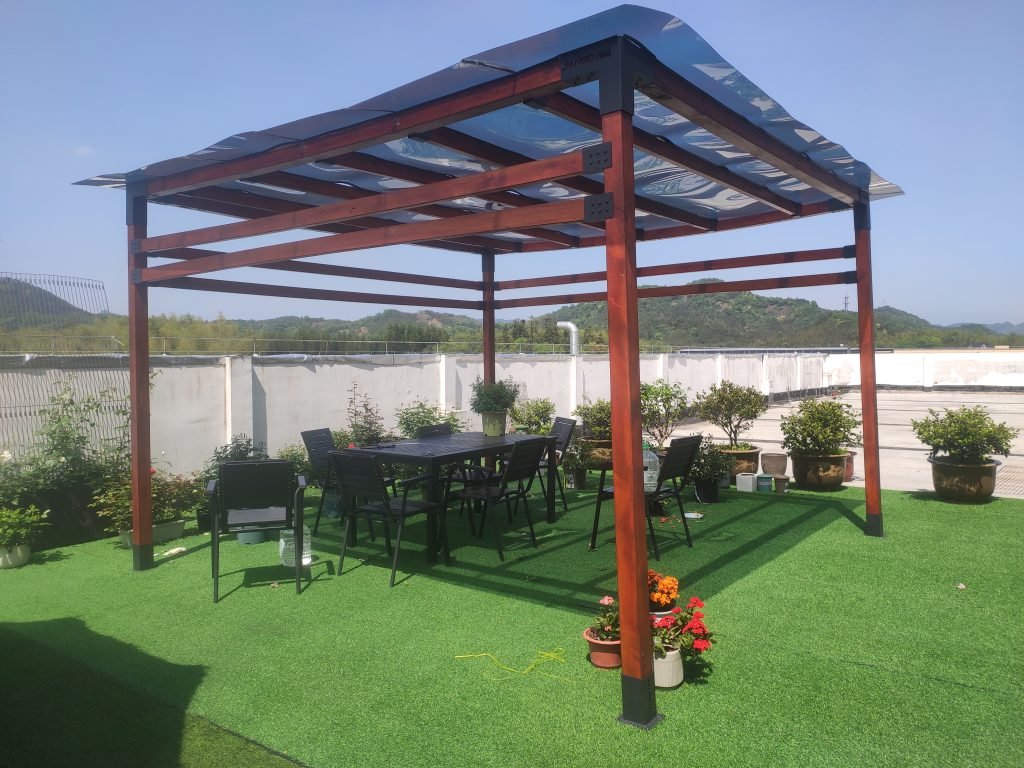
Direct answer: In a B2B pergola project, “steel vs wood pergola brackets” is best treated as a comparison between a steel connector system and a traditional timber-joinery connection. Steel brackets can make interfaces, hardware kits, replacement parts, and installation steps easier to standardize. Traditional wood joinery can reduce the visibility of metal components and suit projects where the timber connection itself is part of the design. Neither route is automatically stronger, cheaper, or more durable. The correct choice depends on project loads, timber properties, joint geometry, fasteners, exposure, installation control, local design requirements, and the validation plan.
What does “steel vs wood pergola brackets” actually mean?
A steel bracket is a manufactured connector that transfers forces between posts, beams, rafters, and anchors through defined contact surfaces and fasteners. A traditional wood connection transfers those forces through timber geometry—such as housed joints, laps, shoulders, or other designed joinery—often combined with concealed or visible fasteners.
Buyers should not compare a catalogue bracket with an undefined timber joint. Compare two complete connection systems. For each option, identify the timber section, grain orientation, joint geometry, connector material, fastener pattern, anchor interface, expected loads, exposure, installation sequence, and acceptance tests. A responsible supplier should request these inputs rather than turning a generic “heavy duty” label into an unsupported engineering claim.
Quick comparison for procurement teams
| Decision factor | Steel connector system | Traditional wood connection |
|---|---|---|
| Drawing control | Bracket geometry, holes, welds, finish, fasteners, and timber interfaces can be itemized in a controlled BOM. | Timber joint geometry, machining allowances, fasteners, moisture condition, and field-fit rules must be controlled. |
| Production repeatability | Depends on cutting, forming, welding or fabrication fixtures, hole location, coating, and kit completeness. | Depends on timber variation, machining datum, tool setup, joint fit, moisture, and installer workmanship. |
| Site installation | Can use a defined hardware kit and sequence, but misaligned holes or wrong timber size can stop assembly. | May need skilled fitting and protection against removing too much material at the joint. |
| Appearance | Can be visible, partially concealed, or detailed as an architectural feature. | Can emphasize timber craftsmanship and conceal more of the connection system. |
| Durability controls | Requires compatible steel, coating system, drainage, edge coverage, fasteners, and maintenance assumptions. | Requires suitable timber, moisture management, end-grain protection, joint drainage, fastener compatibility, and maintenance assumptions. |
| Replacement | A revision-controlled connector or kit can be reordered if interfaces remain unchanged. | Replacement may require remachining or field fitting to the existing timber geometry. |
| Inspection | Drawing dimensions, weld condition, hole position, coating appearance, fit-up, and kit count can be checked by lot. | Joint geometry, timber condition, machining quality, fit, fasteners, and protection details need defined acceptance criteria. |
Which system is easier to source at scale?
Steel connector systems are often easier to package as a repeatable SKU because the bracket, fasteners, anchors, labels, and instructions can be controlled in one bill of materials. This advantage only exists when the drawing and revision process is disciplined. A bracket supplier still needs the actual timber dimensions, tolerance strategy, interfaces, finish requirements, and validation method.
Traditional timber connections can also be repeatable when the buyer controls lumber grade or design values, moisture condition, machining program, gauges, fasteners, and installation criteria. The 2024 National Design Specification for Wood Construction provides a recognized US reference for engineered wood design, including mechanical connections and fasteners. The project engineer must determine what provisions apply; citing a standard does not certify a specific pergola.
How should buyers specify a steel pergola connector?
Control the timber interface first
State nominal and actual post or beam sections, timber species or applicable design basis, corner conditions, end clearances, moisture assumptions, and allowable installation adjustment. Clarify whether the bracket wraps the timber, sits below it, connects to its face, or forms a post base. A connector cannot compensate for an undefined or changing timber interface.
Define material and fabrication requirements
The drawing should identify material designation or an approved-equivalence process, thickness, formed radii, weld symbols where applicable, hole size and position, edge treatment, visible-surface classes, and prohibited repairs. Do not accept “steel” as a complete material specification. Require any proposed material, process, factory, tooling, or sub-supplier change to follow written change control.
Specify the finish as a system
Define surface preparation, coating or plating family, color and gloss reference where relevant, masking areas, thread protection, edge coverage, repair rules, packaging protection, and inspection method. If corrosion testing is required, state the test method, specimen preparation, duration, evaluation points, and pass/fail criteria. A test method alone does not predict service life.
Lock the hardware kit
List every bolt, screw, washer, nut, anchor, cap, label, and instruction sheet. State material and finish compatibility, quantity per set, substitution rules, packaging configuration, and traceability. Use the Pergola Bracket Kit BOM procurement checklist to structure this package.
How should buyers specify a traditional wood connection?
Define the joint rather than saying “wood bracket”
Use a controlled detail showing shoulders, housings, laps, notches, bearing areas, fasteners, edge and end distances, and field-fit limits. Clarify which surfaces are structural and which are cosmetic. If a concealed metal fastener or plate is still part of the joint, include it in the BOM and inspection plan.
Control timber condition and machining
State the required timber basis, moisture condition at machining and installation, visible defect rules, machining datum, tool marks, tear-out limits, and fit-up acceptance. A joint that is correct in dry shop material can behave differently if field moisture or section size changes. These variables belong in the project design and installation plan.
Protect the connection from water retention
Detail drainage, ventilation, end-grain treatment, ground clearance, exposed cuts, and maintenance access. Traditional joinery is not automatically corrosion-free because mechanical fasteners, anchors, or concealed plates may still be present. The timber and all metal components must be compatible with the exposure and treatment system selected by the project team.
What should the RFQ package contain?
Send the same project-level input to every bidder so quotations remain comparable:
- assembly and connection drawings with revision identifiers;
- actual timber sections and interface tolerances;
- design loads, load combinations, governing rules, and engineer-approved acceptance criteria;
- connector or joint materials and approved-equivalence procedure;
- fastener and anchor schedule;
- surface finish, timber protection, exposure, and maintenance assumptions;
- approved sample or first-article requirements;
- inspection plan, measuring method, records, and nonconformance process;
- packaging, labels, spare parts, manuals, and carton configuration;
- forecast, order quantities, destination, and required documentation.
For structural load paths, coordinate with a qualified engineer. The supplier’s catalogue, render, or sample appearance is not a substitute for project-specific design verification. The load ratings, bolt specifications, and span selection guide explains the inputs buyers should request before relying on a bracket configuration.
How do you validate the chosen system?
Approve a representative first article
Use the intended drawing revision, materials, tooling, finish, fasteners, timber interface, and packaging. Record dimensions, visual checks, fit-up, assembly sequence, and any project-defined tests. Photograph critical interfaces and identify the measuring equipment used. The approved sample becomes a reference, but it does not replace the controlled drawing.
Validate the assembly, not only the component
A steel bracket can pass dimensional inspection and still fail to fit an actual post. A machined timber joint can look clean and still have unacceptable play or installation damage. Build a representative assembly or gauge that exercises the relevant post, beam, base, fasteners, anchors, and installation sequence. Define pass/fail criteria before testing.
Use lot inspection with explicit rules
Define lot identity, sample selection, defect classes, acceptance and rejection numbers, tightened or reduced inspection rules, record retention, and escalation. ISO 2859-1:2026 provides sampling schemes indexed by acceptance quality limit for lot-by-lot inspection. The buyer must choose the plan and defect classifications; naming the standard alone is not an inspection plan.
What should be inspected on steel pergola brackets?
- material documents and revision match;
- overall geometry, hole position, and timber-interface dimensions;
- forming quality, weld condition, spatter removal, and distortion;
- surface preparation, coating appearance, color reference, masking, and thread condition;
- fit-up with a controlled timber or gauge;
- fastener and anchor identity, finish, quantity, and substitutions;
- labels, manuals, packaging protection, and carton count.
Jiansen buyers can use the post-base anchoring and corrosion guide to define base-interface and exposure questions. Any manufacturing capability, finish, material, or test requirement should be confirmed in writing for the exact project.
What should be inspected on wood connections?
- timber identity and project-required condition;
- joint geometry, bearing surfaces, shoulders, notches, and edge distances;
- machining tear-out, splits, damage, and prohibited repairs;
- fit-up, play, field adjustment, and assembly sequence;
- fastener identity, pilot-hole rules, tightening method, and concealed hardware;
- water-shedding details, exposed cuts, protection, and maintenance access;
- part marks, orientation labels, packaging, and site documentation.
Which option is better for OEM and wholesale programs?
Choose a steel connector system when the program benefits from a controlled hardware kit, repeatable replacement parts, faster installer training, defined finish variants, and scalable packaging. Choose traditional wood joinery when the architectural intent prioritizes timber craftsmanship, the project has controlled machining and skilled installation, and the connection is engineered for the specific timber and exposure.
A hybrid system is also common: timber carries the visual language while concealed plates, fasteners, or post bases provide selected interfaces. Treat the hybrid as its own engineered system. Do not combine a steel bracket drawing and a timber-joint detail without checking load paths, fastener conflicts, moisture traps, tolerances, and installation access.
Supplier audit checklist
- Can the supplier work from revision-controlled drawings and BOMs?
- How are material and approved-equivalent substitutions controlled?
- What fixtures, gauges, templates, or CNC programs control interfaces?
- How are welds, machining, surface preparation, coating, and repair documented?
- Can the supplier build and record a representative fit-up assembly?
- How are fasteners, anchors, labels, and manuals prevented from being mixed?
- What happens when inspection rejects a lot?
- How are changes to factories, tooling, materials, finishes, and sub-suppliers approved?
- Can packaging protect visible edges and keep complete project kits together?
The ISO 9000 family provides a quality-management framework, but a supplier’s management-system claim does not certify a particular pergola connector or timber joint. Confirm certificates, scope, technical capability, samples, and project records separately.
FAQ
Are steel pergola brackets stronger than wood connections?
Not automatically. Strength depends on the complete load path, including timber properties, joint geometry, bracket material, fasteners, anchors, edge distances, installation, and project-specific validation. Compare engineered systems under the same load cases and acceptance criteria.
What does “wood pergola bracket” mean in this comparison?
It means a traditional timber connection or wood-joinery approach, not a metal bracket made of wood. The RFQ should show the exact joint geometry, fasteners, timber condition, protection details, and field-fit rules.
When is a steel connector system easier to procure?
It is easier when the buyer needs a repeatable bracket and hardware kit with controlled drawings, replacement parts, finish variants, labels, installation instructions, and lot inspection. That advantage disappears if timber interfaces or fasteners are undefined.
When is traditional wood joinery preferable?
It can be preferable when the architectural intent emphasizes timber craftsmanship and the project controls timber properties, machining, skilled fit-up, moisture management, fasteners, and structural verification.
Should I compare price per bracket?
Compare installed-system cost instead. Include design work, timber machining, connectors, fasteners, finish, packaging, installation time, field adjustment, rejected parts, maintenance access, and replacement logistics. A unit-price comparison alone can hide major project costs.
What documents should be approved before mass production?
Approve the assembly drawing, connection details, BOM, materials, fasteners, finish system, first article, fit-up record, validation plan, inspection plan, packaging specification, labels, manuals, and change-control route.
Conclusion
Steel vs wood pergola brackets is not a universal winner-takes-all comparison. Steel connector systems favor repeatable hardware kits, controlled interfaces, replacement parts, and scalable installation. Traditional timber connections favor a crafted wood expression but demand disciplined timber selection, machining, fit-up, moisture control, and installation. For OEM or wholesale sourcing, compare the two systems using the same project loads, drawings, acceptance criteria, documentation, and life-cycle assumptions. To review a specific connector package, share the timber sections, connection drawings, exposure, hardware schedule, validation requirements, and order context through the Jiansen contact page.
