
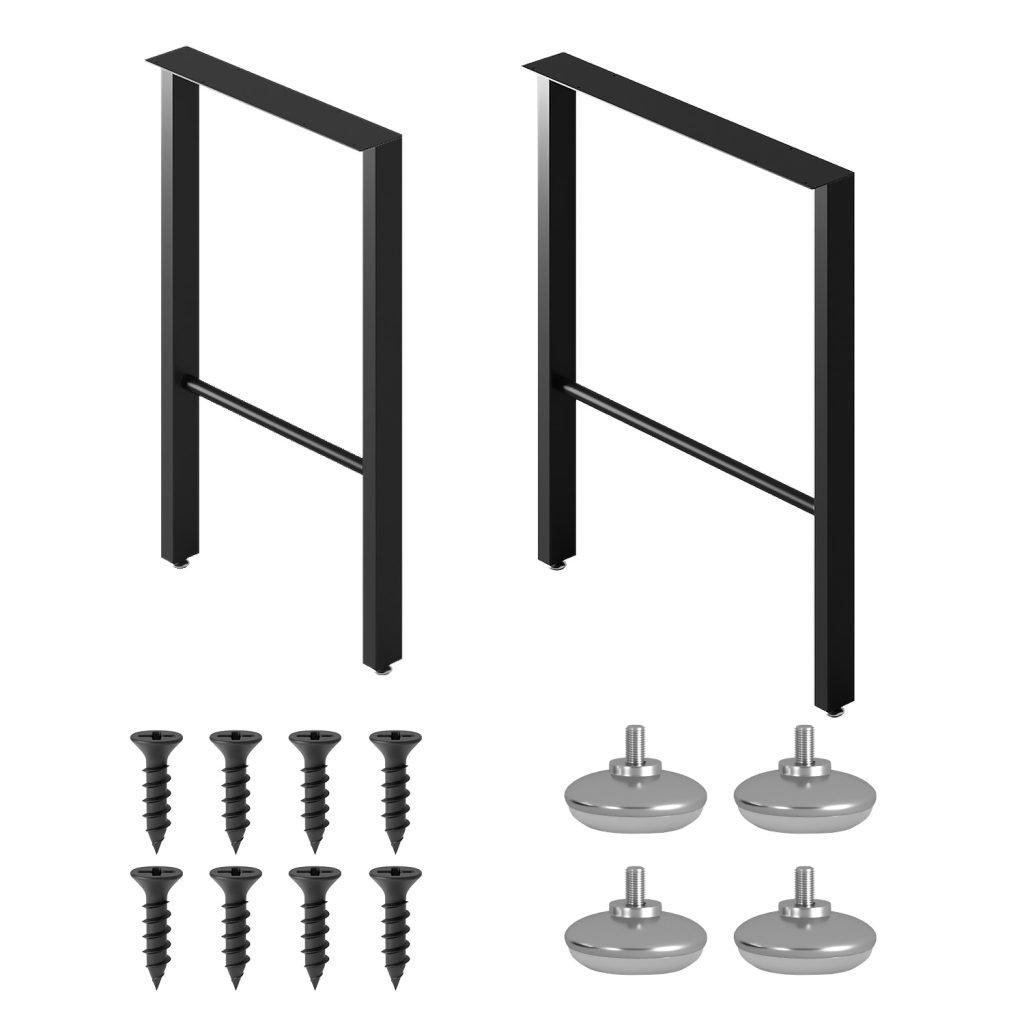
Direct answer: Choose a metal furniture frame manufacturer by sending every candidate the same revision-controlled RFQ, then comparing fabrication fit, documented process controls, sample evidence, inspection methods, packaging, and change control. Define the complete furniture assembly and mounting interfaces before asking for a quote. Do not approve a supplier from photographs, an unverified capability claim, or the lowest unit price alone.
This guide is for furniture brands, importers, distributors, contract-furniture teams, and OEM buyers sourcing welded, formed, or mechanically assembled metal frames. It covers supplier comparison, specification fields, sampling, quality control, installation interfaces, and the evidence needed before release. It does not assign unsupported certifications, capacity, performance ratings, order quantities, production schedules, prices, or compliance claims to any supplier.
Define the frame before comparing manufacturers
A metal frame is part of a system, not an isolated shape. The buyer should describe the tabletop, seat, cabinet, upholstery, panel, or other supported component; how that component attaches; and what the finished furniture must do. A supplier cannot reliably infer stability, hole positions, access for tools, or packing orientation from a reference image.
Start with a controlled assembly drawing. Give every part a number and revision. Identify datums and dimensions that affect fit. Show welded joints, mechanical joints, inserts, slots, mounting plates, feet, glides, and any buyer-supplied parts. If engineering decisions remain open, label them as questions for design review rather than allowing silent assumptions.
Record these RFQ fields
| RFQ field | Buyer input | Supplier response or evidence |
|---|---|---|
| Application | Furniture type, intended environment, mating components, installation sequence | Feasibility questions and stated assumptions |
| Geometry | 3D file, dimensioned PDF, datums, critical dimensions, general tolerances | Marked-up drawing and proposed process route |
| Material | Buyer-approved grade, form, thickness, and permitted substitution process | Material source and traceability record to be supplied |
| Joints | Weld symbols or fastening requirements, visible surfaces, access constraints | Joint sequence, fixture approach, and inspection method |
| Mounting interface | Hole and slot sizes, center distances, threads, inserts, edge distances | Interface confirmation against assembly drawing |
| Finish | Color or master reference, texture, gloss expectation, exposed faces, masked zones | Pretreatment and finishing route for approval |
| Inspection | Critical characteristics, methods, tools, sampling approach, record format | Control plan and sample report |
| Packaging | Set quantity, protection points, label data, carton limits, pallet rules | Pack-out proposal and packaging sample |
| Commercial request | Forecast, order quantity, shipment split, destination, Incoterm request | Quoted assumptions, exclusions, and separately stated terms |
For adjacent product examples and terminology, review Jiansen’s public metal furniture leg category. Treat catalog content as discovery material only; the approved RFQ, drawings, bill of materials, and sample record should control the order.
Compare fabrication routes against the design
The best manufacturing route depends on section shape, annual demand, visible surfaces, dimensional risk, and tooling economics. Ask candidates to explain how they would produce each feature and where variation could enter. A credible response identifies operations and inspection points rather than simply saying that the design is “no problem.”
| Route | Often considered for | Buyer questions | Approval evidence |
|---|---|---|---|
| Tube cutting, bending, and welding | Frames with repeated tubular rails and legs | How are bend orientation, cut length, joint gaps, and distortion controlled? | Fixture plan, dimensional report, and joint appearance sample |
| Sheet cutting, forming, and welding | Brackets, channels, mounting plates, folded structures | Which bend datums and hole-to-bend dimensions are critical? | First-piece report and flat-pattern revision |
| Laser-cut plate with welded sections | Custom interfaces and lower-volume configurations | How are heat input, flatness, and edge condition managed? | Approved drawing and measured sample |
| Mechanical assembly | Knock-down frames or serviceable joints | How are fastener access, orientation, thread engagement, and loose parts controlled? | Assembly trial and pack-out check |
| Mixed-process frame | Frames combining cast, machined, formed, or tubular components | Who controls interfaces and changes across processes? | Complete BOM, interface review, and traceable sample |
A factory may use subcontracted operations. That is not automatically a rejection point, but the quote should identify which operations are external, how incoming results are verified, and who owns a nonconformance. Evaluate the complete process chain, not only the final assembly station.
Compare suppliers with the same evidence matrix
Use a weighted decision sheet so commercial pressure does not erase technical gaps. Keep capability, evidence, and risk separate. A claimed process is not the same as a record from the proposed route, and a sample that looks acceptable does not prove that later revisions will remain controlled.
Score what can be demonstrated
- Requirement review: Are assumptions, exclusions, and unclear features returned in writing?
- Drawing control: Can the supplier keep part numbers and revisions aligned across quotation, sample, purchase order, work instruction, and inspection record?
- Process fit: Does the proposed cutting, forming, fixturing, joining, and finishing sequence suit the geometry?
- Measurement: Are methods and tools appropriate for the critical dimensions and interfaces?
- Change control: Is written approval required before material, process, tooling, or subcontractor changes?
- Packaging validation: Does the proposed pack protect visible finishes and prevent component mixing?
- Corrective action: Does the supplier define containment, evidence, disposition, and recurrence prevention?
Request comparable documents from each candidate: marked-up RFQ, process flow, sample inspection report, finish reference, packaging proposal, and a list of unresolved points. Jiansen or any alternative should be evaluated against the same buyer-defined criteria.
Control material, drawings, and substitutions
Write the material requirement in the approved drawing and BOM. Avoid vague terms such as “steel,” “stainless,” or “aluminum” when grade and product form matter. State how material records will be linked to the purchase lot. If substitution could be acceptable, define a written review path; never authorize an unstated equivalent.
General tolerances may be referenced where appropriate, but interface and critical-to-function dimensions need explicit limits. The official ISO 2768-1 listing describes general tolerances for linear and angular dimensions without individual tolerance indications. Referencing a standard on a drawing is not the same as claiming that a product or supplier is certified.
Freeze one document hierarchy
The purchase order should identify which document controls if requirements conflict. A practical hierarchy can place the signed deviation record and approved drawing above the supplier catalog, followed by the BOM, finish standard, packaging file, and inspection plan. Record the hierarchy in the order rather than resolving conflicts after production.
Approve a representative sample
A sample should represent the decisions it is intended to approve. Record its part number, revision, material, process route, finish reference, and deviations. If it was produced with temporary tooling or a nonproduction finish, say so. The buyer must decide which checks need repeating when the production route changes.
- Review the supplier’s marked-up RFQ and close open questions.
- Freeze the sample drawing, BOM, finish reference, and packaging scope.
- Measure critical dimensions and mounting interfaces using recorded methods.
- Assemble the frame with representative mating components and buyer-approved fasteners.
- Check level contact, orientation, tool access, hole alignment, joint appearance, and visible finish.
- Record defects, concessions, corrections, and required resubmission.
- Approve in writing or issue a revised document set and repeat affected checks.
Do not infer a safe working load or service life from a visual sample. If the project requires structural, stability, impact, cyclic, corrosion, or market-specific testing, the buyer should name the applicable method, configuration, laboratory expectations, and acceptance criteria. The U.S. Consumer Product Safety Commission provides a starting point for identifying applicable furniture business guidance; the buyer remains responsible for determining requirements in each destination market.
Build inspection around critical interfaces
Inspection should connect every check to a specification source, method, acceptance criterion, and result. A generic “QC passed” stamp is not sufficient. For the first production lot, increase attention on characteristics affected by fixtures, welding sequence, forming, and finishing. Later sampling can only follow a buyer-approved plan based on documented risk and history.
Use a receiving checklist
- Verify purchase order, part number, revision, quantity, and lot identity.
- Match material documentation to the defined traceability requirement.
- Measure critical overall dimensions, mounting-hole locations, and interface features.
- Check frame contact points and assembly fit with the approved mating setup.
- Inspect weld location and workmanship against the approved visual and drawing requirements.
- Inspect finish color, texture, coverage, masking, damage, and protected contact points.
- Confirm loose parts, labels, instructions, and set completeness.
- Record nonconformities and quarantine affected units pending written disposition.
For sampling terminology and plan selection, buyers can consult the official ISO 2859-1 listing. Do not copy a sampling level or acceptance number from another program without buyer approval. The standard reference does not establish product compliance by itself.
Specify welding and finishing without unsupported promises
Where welding is used, place joint location, required process information, visible-surface expectations, and inspection method in controlled documents. Ask how fixtures, tack sequence, heat input, and post-weld handling address distortion. Safety controls belong to the manufacturer’s workplace system; OSHA’s official welding, cutting, and brazing resources explain relevant occupational hazards and controls, but citing them does not certify a supplier or product.
Finish names are incomplete specifications. For powder coating or another coating route, define substrate preparation, approved visual reference, exposed faces, masked areas, acceptable variation, and packing protection. For brushed or polished surfaces, define direction and appearance reference. If the buyer requires a corrosion test, name the method, sample preparation, evaluation rule, and acceptance threshold in the RFQ. Do not translate a laboratory result into an unsupported outdoor-life claim.
Plan installation and assembly before shipment
An installation guide should be specific to the approved furniture assembly. It must not substitute for qualified engineering where the application requires it. At minimum, the controlled instruction should identify each component, orientation, installation sequence, tool access, buyer-approved fasteners, mating substrate, and final inspection points.
Run a documented assembly trial
- Confirm that frame, mating component, inserts, and fasteners match the approved revisions.
- Place parts on a protected, level work surface and identify orientation.
- Start all connections without forcing misaligned holes or modifying parts.
- Follow the buyer-approved tightening sequence and any specified installation values.
- Check full contact, clearances, rocking, interference, visible damage, and loose components.
- Record the result and escalate any deviation instead of reworking without authorization.
If fastener type or tightening requirements have not been engineered, mark them as open items. A manufacturer should not invent those values. Buyers needing a related sourcing workflow can compare the separate table base manufacturer checklist, while project-specific drawings should remain the controlling source.
Send a complete request for quotation
A strong RFQ reduces hidden assumptions and makes supplier quotations comparable. Include company and project identification, intended market, application, forecast and requested quantity, drawing and BOM revisions, material, manufacturing notes, finish, interface data, inspection plan, sample scope, packaging, labeling, required documents, destination, requested trade term, and target milestones. Ask the supplier to list every exclusion and proposal separately.
Do not require a candidate to state unsupported commercial or technical values merely to fill a template. Where information is unknown, request a documented proposal and evidence for buyer review. To begin a project-specific discussion with Jiansen, use the public contact page and attach a controlled RFQ package rather than relying on an informal product name.
Use a final supplier-release checklist
- Supplier identity and manufacturing location are recorded.
- All outsourced operations and control responsibilities are disclosed.
- Part number, drawing, BOM, finish, packaging, and inspection revisions agree.
- Open assumptions and deviations have written dispositions.
- The representative sample and assembly trial are documented.
- Critical characteristics have methods and buyer-approved acceptance criteria.
- Material and lot traceability requirements are defined.
- Packaging protects visible surfaces and keeps sets complete.
- Change control and nonconformance escalation are written into the order.
- No certification, load, durability, corrosion, order-quantity, schedule, price, or compliance statement is accepted without project-specific evidence.
Frequently asked questions
What should a metal furniture frame manufacturer RFQ include?
Include the application, intended market, assembly drawing, part drawings, BOM, material, critical dimensions, mounting interfaces, joint notes, finish reference, quantity request, sample scope, inspection plan, packaging, destination, and trade-term request. Identify document revisions and ask the supplier to return assumptions and exclusions in writing.
How should buyers compare metal furniture frame suppliers?
Send the same controlled RFQ to every candidate and compare documented evidence for requirement review, drawing control, fabrication route, measurement, sample approval, packaging, change control, and corrective action. Keep capability claims, supporting records, commercial terms, and unresolved risks in separate columns.
Does an approved sample authorize production automatically?
No. The sample record must state what it represents and list all deviations. Production should begin only after the buyer approves the relevant drawing, BOM, material, finish, process assumptions, inspection requirements, packaging, and change-control terms.
Which metal is best for a furniture frame?
There is no universal best metal. Selection depends on geometry, joining and forming route, component weight, appearance, exposure, maintenance, cost objectives, and applicable market requirements. The buyer and supplier should record the approved grade and form in the controlled specification.
What should be checked during a frame assembly trial?
Check revision identity, orientation, mounting-hole alignment, contact surfaces, clearances, installation access, approved fasteners, interference, rocking, finish damage, and set completeness. Record results against buyer-approved criteria and do not force or modify nonconforming parts.
Can a supplier promise load capacity or corrosion life from a similar product?
No. A similar photograph, catalog item, or general material description is not project-specific evidence. If load, stability, durability, or corrosion performance matters, define the test method, configuration, evidence, and acceptance criteria for the actual frame and intended assembly.
When should a metal furniture frame be resampled?
Resampling should be considered when an approved characteristic changes, including material, drawing revision, tooling, fixture, joint method, finish route, subcontractor, packaging, or a corrective action that affects fit or appearance. The buyer should define which checks repeat and approve the change in writing.
Conclusion
A defensible sourcing decision converts the furniture concept into controlled interfaces, documents, evidence, and release rules. Compare manufacturers by what they can demonstrate on the proposed process, approve a representative assembly, and keep revisions aligned from RFQ through receiving. This approach supports a more reliable quotation and production handoff without relying on unsupported marketing claims.
