
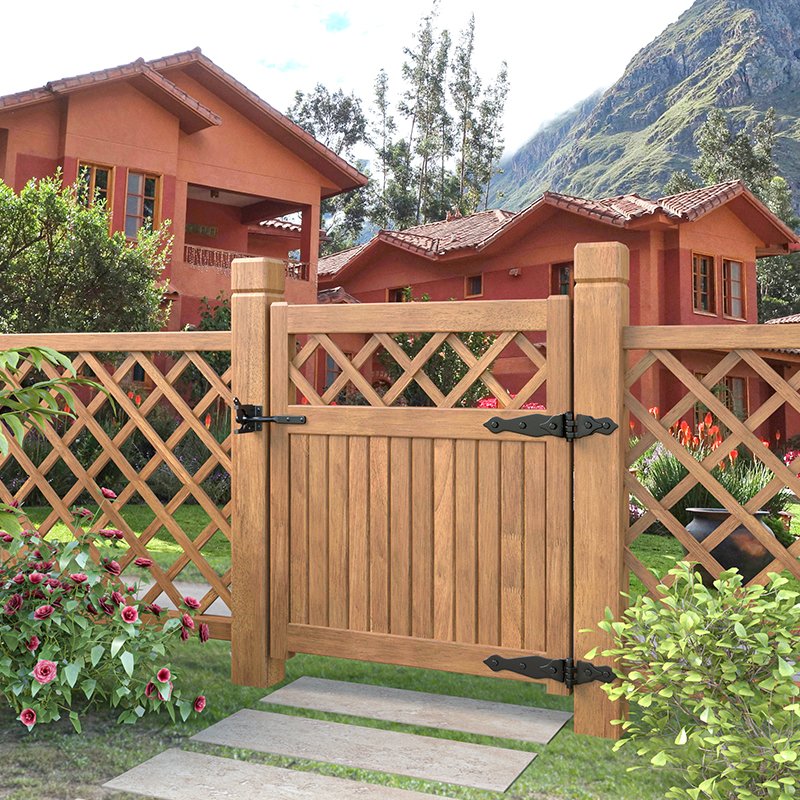
Fence hinges should be selected as a load-and-environment system, not as a decorative accessory. A buyer needs to match hinge geometry, base metal, finish, fasteners, gate construction, duty cycle, and exposure conditions. T/tee hinges are economical for many timber gates; strap hinges spread load across wider leaves; heavy-duty designs suit larger or frequently operated gates; and self-closing models add controlled return where closure is required. For wholesale or OEM purchasing, define the gate height, width, weight, frame material, opening frequency, environment, finish, and order quantity before asking a supplier to recommend or quote a configuration.
For distributors, fencing contractors, importers, and private-label brands, that specification-first approach reduces sample revisions, installation complaints, and mismatched inventory. This guide explains how to build a commercially useful hinge specification without relying on unsupported load claims.
Main Types of Fence Hinges
Hinge names are useful starting points, but the same label can cover different plate thicknesses, pin constructions, hole patterns, and finishes. Drawings and samples should therefore accompany the type name in a purchase specification.
T or Tee Hinges
A T hinge combines a vertical mounting leaf with a long horizontal strap. The shape is common on timber gates because the strap can run across a rail while the shorter leaf fixes to the post or frame. It offers straightforward installation and a familiar appearance for agricultural, garden, and privacy-fence programs.
Commercial buyers should compare strap length, material thickness, pin design, hole spacing, edge quality, and fastener compatibility. Longer-looking is not automatically stronger: performance depends on the complete geometry, base material, joints, fasteners, and substrate. Request the hinge manufacturer’s tested load data for the exact configuration rather than applying a generic capacity to every T hinge.
Strap Hinges
Strap hinges use elongated leaves to distribute force over a larger area of the gate. They are often specified for wide timber gates, framed gates, or designs where the hinge is intentionally visible. Straight, cranked, offset, and decorative profiles can solve different alignment and visual requirements.
For OEM programs, define the open and closed positions, required offset, handedness if applicable, hole pattern, and whether the strap must align with a structural gate rail. A product that fits the panel but misses the internal rail can transfer force into cladding instead of the load-bearing frame.
Heavy-Duty Hinges
“Heavy-duty” is not a universal rating. It may describe thicker leaves, a larger pin, welded construction, bearings or bushings, adjustable geometry, or simply the supplier’s product family. The correct comparison is based on tested performance for the proposed gate, mounting method, and operating conditions.
Use heavy-duty designs when gate mass, width, wind exposure, impact risk, or operating frequency exceeds the assumptions of a standard hinge. Buyers can review this overview of heavy-duty fence gate hinges before preparing an RFQ, but the final choice should still follow tested load data and local code.
Self-Closing Hinges
Self-closing models incorporate a spring or another return mechanism to move the gate toward the closed position. They are useful in access-control, shared-property, commercial, and other applications where an unlatched open gate creates an operational problem. Selection factors include adjustment range, closing consistency, gate clearance, latch compatibility, installation orientation, and maintainability.
A self-closing hinge does not guarantee that a gate will latch under every condition. Gate alignment, wind, closing speed, latch resistance, temperature, and spring setting all matter. Evaluate features to look for in self-closing fence gate hinges and validate the assembled gate during sampling. A buyer comparing coordinated components can also review this black gate hinge and latch kit as a product-format reference, then confirm the exact quoted material, finish, components, and performance for the intended order.
Fence Hinge Selection and Verification Matrix
Use this matrix to prepare an RFQ. Final selection must be confirmed against the exact SKU drawing, BOM, representative gate configuration and approved verification records.
| Buyer input | Information to provide | Selection / verification action | Do not assume |
|---|---|---|---|
| Gate construction | Wood, steel, aluminum or vinyl/composite; identify frame and infill separately | Confirm the load-carrying frame, reinforcement and dissimilar-metal interfaces | The visible skin is not necessarily the structural substrate |
| Gate geometry and mass | Finished width, height, thickness, measured mass and accessory mass | Review center of gravity, hinge spacing, post stiffness and representative-gate validation | No maximum width or mass without an approved SKU-specific test configuration |
| Duty | Average and peak openings; impact or misuse risk | Define adjustable/self-closing needs, wear components and maintenance access | No cycle-life statement without an applicable report |
| Exposure | Indoor, ordinary outdoor, wet, coastal/chloride, industrial chemical or freeze-thaw | Confirm substrate, complete coating stack, fastener compatibility and maintenance | Color alone does not define a corrosion-protection system |
| Hinge format | Tee, strap, self-closing, adjustable, weld-on or bolt-on | Match rail position, offset, opening direction and closing requirement | “Heavy-duty” is not a common rating |
| Finish | Galvanized, powder coated, galvanized plus powder coated, or stainless finish; color and gloss | Request the process card and approved sample where required | No corrosion hours or service-life claim without evidence for the exact configuration |
| Fastening | Wood screw, self-tapping screw, through-bolt, rivet or weld; substrate and backing plate | Confirm hole pattern, fastener material, drainage and galvanic compatibility | No fastener size or torque before drawing/BOM approval |
| Closing and latching | Self-closing need, swing direction, target angle and latch arrangement | Validate hinge and latch together on a representative gate | Self-closing does not by itself guarantee latching |
| Controlled output | Selected SKU, BOM, drawing revision, sample ID and inspection record | Approve a golden sample and change-control route | A marketing page is not an approved engineering drawing |
How to Choose by Gate Material, Size, and Usage
Match the Hinge to the Structural Frame
For a wood gate, fasten into sound rails, stiles, posts, or reinforcement rather than thin boards alone. Timber species, moisture movement, pilot-hole preparation, and screw withdrawal resistance affect long-term stability. Buyers sourcing wood gate hinges should provide a gate drawing that identifies the structural members and fixing locations.
For steel or aluminum gates, confirm whether the hinge will be bolted, riveted, screwed into an insert, clamped, or welded. Thin-wall tube may need backing plates, threaded inserts, or reinforced hinge zones. Also assess galvanic compatibility where different metals can remain wet in contact.
For vinyl or composite gates, the visible profile is generally not the primary load path. Confirm the reinforcement material, wall thickness, internal access, and manufacturer-approved fixing method. The 304 PVC fence hinge installation and maintenance guide provides additional application context, while the gate-system manufacturer’s instructions should govern the final assembly.
Account for Dimensions, Weight, and Load Position
Gate weight alone is insufficient. Width moves the center of gravity farther from the hinge axis and increases leverage on the hinge and post. Height affects hinge spacing and resistance to twisting. Solid panels can also receive higher wind loads than open picket or mesh gates.
Send the supplier the finished gate dimensions, verified weight, frame section, infill type, hinge-side construction, number of hinges, and expected hinge spacing. If wind or code requirements apply, have a qualified project engineer establish the design loads. Follow the hinge manufacturer’s tested load data and local code.
Define the Duty Cycle
A private service gate opened occasionally has different wear demands from a gate at a warehouse, multifamily property, school, or shared access point. Estimate openings per day, peak periods, likelihood of misuse, required closing behavior, and maintenance access. High-frequency service may justify replaceable bushings, adjustable components, more robust pins, or a planned inspection schedule even when the static gate weight appears modest.
Steel, 304 Stainless Steel, and Outdoor Finishes
Coated Carbon Steel
Carbon steel is widely used because it is formable, economical, and compatible with multiple finishes. Its outdoor life, however, depends on surface preparation, coating coverage, edge condition, packaging, installation damage, and maintenance. Zinc plating, galvanizing, e-coating, and powder coating are different processes; a color name such as “black” does not define the corrosion-protection system.
An RFQ should identify the full finish stack, color or approved sample, gloss range if appearance is important, and the intended exposure category. Ask how cut edges, recesses, weld zones, and threaded parts are protected. If a corrosion test is required, agree on the method, sample preparation, acceptance criteria, and reporting before production rather than requesting an undefined number of “salt spray hours.”
A buyer needing a coordinated hinge, latch, drop rod, and fastener pack can review this wholesale wood gate hardware set as a sourcing reference. Treat the product page as a starting configuration and confirm every order-specific detail in the quotation and approved sample.
304 Stainless Steel
304 stainless steel provides useful general outdoor corrosion resistance and avoids reliance on a painted surface for basic protection. It can be suitable for many normal outdoor environments, but “stainless” does not mean immune to staining or corrosion. Chloride-rich, coastal, industrial, or chemically aggressive locations require a project-specific materials review.
Specify the stainless grade for the hinge body, pin, spring, washers, and fasteners—not only the visible leaf. Fabrication contamination and unsuitable cleaning can undermine appearance. Buyers should also define the desired surface finish and packaging method so finished parts do not rub or collect carbon-steel contamination in transit.
Coating and Hardware Compatibility
A premium hinge finish cannot compensate for unprotected screws, damaged installation points, or incompatible mating metals. Specify fastener material and finish as part of the hinge assembly. Consider drainage and avoid crevices that retain water. Where coating is locally damaged during installation, follow the coating supplier’s approved repair process.
Outdoor selection should reflect rainfall, humidity, salt, fertilizer, cleaning chemicals, airborne industrial contamination, UV exposure, and maintenance frequency. Samples should be evaluated in a representative assembled system, not only as loose components.
Installation Geometry and Fastener Principles
Correct geometry keeps the hinge axis aligned and transfers loads into the gate frame and post. Before drilling, verify gate clearance, desired swing, stop position, ground slope, latch alignment, and whether the gate must open one way or both ways. Mount hinge leaves flat against appropriate structural surfaces unless the approved design specifies spacers or offsets.
Place hinges far enough apart to stabilize the gate while keeping both attachment zones structurally supported. A third hinge may help some tall or high-duty gates, but hinge count and location should follow tested configuration data. Do not assume that adding a hinge will correct a flexible post, weak frame, or misaligned axis.
Fastener selection must consider substrate, diameter, length, head style, thread type, corrosion resistance, and installation torque. Use every required fixing hole unless the manufacturer instructs otherwise. Pilot holes should suit the substrate and fastener; undersized holes can split timber, while oversized holes reduce holding power. Through-bolts and backing plates can distribute force where the design permits them. Welding requires an approved procedure and protection of the surrounding finish.
During commissioning, operate the gate through its full travel and check for binding, sag, fastener movement, coating damage, and reliable latching. Reinspect after an initial service period. For self-closing units, adjust return force only within the manufacturer’s instructions and confirm that users cannot easily create a pinch or impact hazard.
B2B RFQ Specification Table
The following table turns a general inquiry into information a manufacturer can quote and engineer against.
| RFQ field | Information to provide | Why it matters |
|---|---|---|
| Gate application | Fence type, project segment, indoor/outdoor use | Establishes operating context |
| Gate dimensions | Finished height, width, thickness, and clearance | Defines geometry and leverage |
| Finished gate weight | Measured or engineered weight, including accessories | Supports tested hinge selection |
| Gate construction | Wood, steel, aluminum, vinyl/composite; frame and infill details | Identifies the real load path |
| Post/frame construction | Section dimensions, wall thickness, reinforcement, substrate | Determines mounting interface |
| Duty cycle | Estimated openings per day and misuse/impact risk | Guides wear and durability choices |
| Hinge type | T/tee, strap, heavy-duty, self-closing, adjustable, or supplier proposal | Narrows the design family |
| Swing requirements | Opening angle, one-way/two-way, offset, handedness, closing behavior | Prevents geometry conflicts |
| Environment | Inland, coastal, humid, industrial, chemical, freeze/thaw, maintenance level | Guides material and finish review |
| Material and finish | Base metal, stainless grade, coating stack, color, texture/gloss | Controls corrosion and appearance |
| Fasteners | Substrate-specific type, material, finish, quantity, inclusion/exclusion | Ensures system compatibility |
| Validation | Required drawings, samples, tests, inspection records, acceptance criteria | Aligns quality expectations |
| Packaging | Bulk, retail pack, kit components, labels, barcode, manual, carton marks | Enables distribution readiness |
| Commercial data | Forecast, trial order, annual volume, destination, Incoterm request | Supports an accurate quotation |
OEM/ODM Development and Quality Control
OEM can cover logo marking, finish color, hole pattern, packaging, labeling, and coordinated gate hardware kits. ODM may involve deeper changes to leaf geometry, adjustment features, spring behavior, mounting interfaces, or component architecture. In either case, start with a controlled specification and revision-numbered drawings.
A practical approval sequence is:
- Application review: Supplier and buyer confirm gate construction, exposure, duty cycle, and target market.
- Drawing approval: Review dimensions, tolerances, hole locations, materials, finish callouts, and component list.
- Sample approval: Install samples on a representative gate and record fit, swing, closing, latch engagement, and appearance.
- Validation plan: Agree on functional cycling, load evaluation, coating checks, dimensional inspection, and packaging tests appropriate to the product.
- Golden sample: Sign and retain a production reference with an approved drawing and packaging standard.
- Production control: Check incoming materials, critical dimensions, assembly, finish, function, count, labels, and carton condition.
- Change control: Require written approval before changes to materials, processes, sub-suppliers, tooling, or packaging.
Quality documents should identify the product revision, lot, test method, sample quantity, equipment, results, and acceptance decision. Avoid vague requests such as “export quality.” Define measurable characteristics that purchasing, engineering, and inspection teams can interpret consistently.
For projects requiring a broader set, browse the fence gate hardware category and specify which hinges, latches, handles, rods, fasteners, and instructions must be packed together. Kit completeness is a separate QC checkpoint from individual component quality.
Common Fence Hinge Purchasing Mistakes
- Buying by gate weight alone: Gate width, wind exposure, frame stiffness, and duty cycle can materially change the demand on the hinge system.
- Treating “heavy-duty” as a comparable rating: Ask for drawings and tested data for the exact hinge, fasteners, substrate, and spacing.
- Specifying only a finish color: “Black” may describe paint, powder coating, plating plus coating, or another system. Define the finish construction.
- Ignoring the fasteners: Incorrect length, thread, material, or corrosion protection can make a suitable hinge fail at the attachment.
- Mounting into cladding: Hinge forces need a structural path into the gate frame and post.
- Skipping assembled samples: Loose-part inspection cannot reveal swing interference, latch mismatch, closing behavior, or gate sag.
- Assuming self-closing means self-latching: The complete assembly must overcome friction and engage the selected latch reliably.
- Leaving packaging until the end: Mixed fasteners, scuffed finishes, missing instructions, and weak cartons create avoidable claims.
- Using unverified supplier claims in sales materials: Publish only approved specifications and applicable evidence for the purchased SKU.
Related Fence Gate Hardware
- JL1907 Steel / Wood Fence Gate Hinge — webpage records a 7-3/8 in × 3-1/2 in, 2 mm hinge format and a 2-hinge / 12-screw pack; confirm material variant and approved drawing before specification.
- JL1902 SS304 PVC Fence Hinges — PVC/vinyl-gate product route; confirm every component material and fastener interface for the project environment.
- Self-closing Fence Gate Hinge — use where a self-closing mechanism is required; closing and latching must be validated together.
- JL2223 Strap Hinge and JL2226 Wooden Door Strap Hinge — strap-hinge product routes; confirm geometry and hole pattern by drawing.
- JS241023 Fence Hardware Kit — webpage dimensions are 146.5 × 90 mm and 3 mm; webpage material descriptions conflict (steel vs aluminum), so material is pending engineering verification.
- JL2234 Wood Fence Hardware Kit — webpage pack counts may support RFQ preparation; map the listed 2.5/3/2 mm values to components before publication.
- JL2227 Vinyl Fence Gate Hardware — webpage route for wood/vinyl applications; component thickness mapping remains to be confirmed.
- Coordinate hinges with JL1904 Fence Gate Latch, JL2222 Wooden Gate Latch and JL2221 Chain Link Fence Gate Latch.
- Complete gate-hardware RFQs may also reference JL1910 Cane Bolt, JL1911 Heavy Duty Cane Bolt, JL2224 Wooden Fence Gate Drop Pin and JL2210 Thumb Gate Latch.
FAQ
What type of fence hinge is best for a wooden gate?
A T/tee or strap hinge is a common starting point because its long leaf can attach across a structural rail. The best choice depends on the finished gate width, height, weight, frame layout, duty cycle, and exposure. Fix the hinge into sound structural members and follow the hinge manufacturer’s tested load data rather than selecting by appearance alone.
How many hinges does a fence gate need?
The required number depends on the hinge design, gate dimensions and weight, hinge spacing, mounting substrate, duty cycle, and environmental loads. Two hinges may suit some gates, while taller or demanding assemblies may require three or a different hinge system. Use the manufacturer’s tested configuration and local code; do not add hinges as a substitute for a rigid post and frame.
Are 304 stainless steel fence hinges suitable outdoors?
304 stainless steel is suitable for many general outdoor applications, provided the full assembly and fasteners are compatible and maintained. It is not immune to staining or corrosion. Coastal, chloride-rich, industrial, or chemical exposure requires a project-specific material review and may call for a different grade or protection strategy.
What information should a buyer include in a fence hinge RFQ?
Include gate height, width, finished weight, frame and post materials, structural sections, opening frequency, swing and closing requirements, exposure environment, preferred material and finish, fastener needs, packaging, order quantity, destination, and required drawings or validation. Photos and dimensioned gate drawings help prevent assumptions.
Can self-closing fence hinges guarantee that a gate will latch?
No. They provide return force, but successful latching also depends on alignment, gate clearance, hinge adjustment, latch resistance, wind, temperature, and maintenance. Test the selected hinges and latch together on a representative gate, then define the acceptable closing and latching behavior in the approval plan.
What should be inspected before approving an OEM hinge order?
Approve revision-controlled drawings, materials, finish, critical dimensions, hole pattern, pin or spring function, fasteners, installation fit, packaging, and labeling. Install samples on a representative gate and agree on test methods and acceptance criteria. Keep an approved golden sample and require written change control for production.
Request a Fence Hinge Recommendation and Quote
For a selection review or OEM/wholesale quotation, submit the gate height, gate width, finished weight, frame material, opening frequency, exposure environment, required surface finish, and order quantity. Add a gate drawing, post details, swing direction, closing requirement, fastener preference, packaging needs, and destination when available. Jiansen can then review the application and propose a configuration for buyer approval; final use should follow the hinge manufacturer’s tested load data and local code.
