
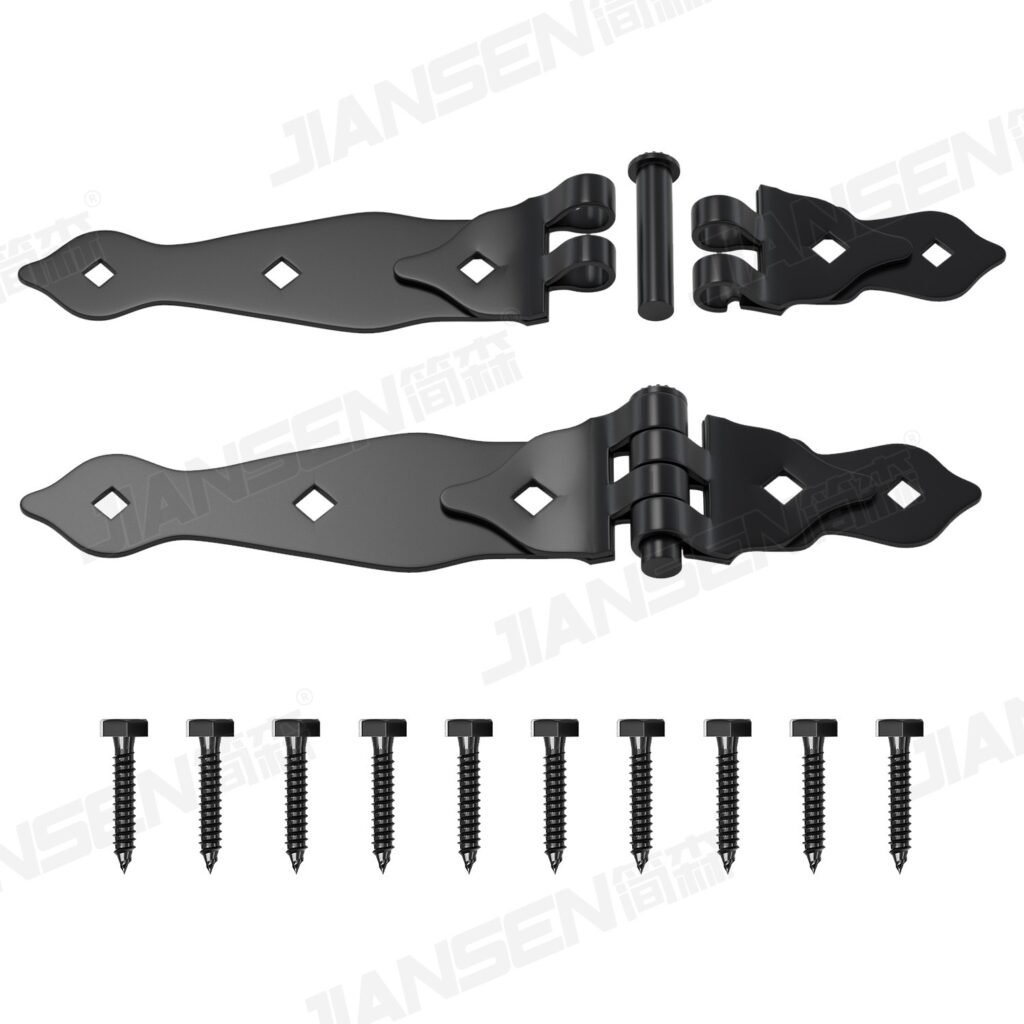
Strap hinges are surface-mounted hinges with a long leaf that spreads the connection across a wooden gate or shed-door frame. To specify them correctly, match the hinge geometry and hole pattern to the structural rail or stile, confirm the gate and post construction, select a finish and compatible fastener system for the exposure, and install to approved drawings or the door manufacturer’s instructions. Do not fasten a hinge only to pickets, cladding, or thin trim.
For distributors, importers, fence contractors, and private-label buyers, that short answer becomes a repeatable purchasing process: define the application, approve a dimensioned drawing and bill of materials (BOM), validate the installation on the actual substrate, and lock the approved sample to production inspection criteria. This guide focuses specifically on strap hinge installation and B2B specification. For a broader comparison of hinge families, applications, and sourcing decisions, use Jiansen’s fence hinges pillar guide.
What Is a Strap Hinge, and Where Does It Fit?
A strap hinge has an elongated surface leaf attached to the moving gate or door and a mating section attached to the fixed support. Its visible footprint makes hole position, edge distance, frame layout, and finish part of the specification—not afterthoughts.
Typical commercial applications include wooden fence gates, shed doors, utility enclosures, and selected decorative doors. Suitability is not established by appearance alone. A buyer should identify the gate’s dimensions, construction, operating frequency, wind exposure, mounting substrate, post condition, clearances, and required opening behavior before choosing a hinge.
The distinction between structural framing and decorative boards is critical. DuraLink’s fence accessories guide similarly advises mounting hinges to solid structure rather than weak pickets or thin trim. On a wood gate, that normally means aligning the strap with a structural rail or stile and attaching the fixed side to a sound structural post or frame member. The project designer or gate manufacturer must approve the final connection.
Strap Hinge Types for B2B Range Planning
A product line can classify strap hinges by connection layout and operating function without turning the assortment into a list of unverified performance claims.
- Straight strap hinges: A simple elongated leaf for surface mounting where the gate rail and post arrangement accept a direct connection.
- T-hinges: A strap-like gate leaf combined with a compact frame leaf; often considered when the fixed-side mounting area is limited.
- Cranked or offset configurations: Geometry changes the relationship between the gate face, pivot, and post. Buyers must approve the actual offset and clearance drawing.
- Adjustable configurations: Adjustment features may help installation alignment, but their range, method, and locking procedure must be documented for the quoted item.
- Decorative strap patterns: Shape and finish support a traditional visual language, while the mounting substrate and connection still require engineering review.
Do not treat these labels as interchangeable. Two products called “strap hinges” can differ in leaf length, width, thickness, pivot geometry, hole count, hole shape, fastener package, and finish system.
Sizing Strap Hinges: Use the Connection, Not a Rule of Thumb
There is no responsible universal hinge-length formula for every wooden gate or shed door. Start with the complete opening and connection, then use an approved drawing or the gate manufacturer’s instructions.
Information required before sizing
- Record gate or door height, width, thickness, construction, and intended orientation.
- Identify the structural rails and stiles behind the visible boards.
- Record the fixed support: wood post, framed jamb, metal post, or another approved substrate.
- Confirm clearances, swing direction, stops, latch position, and any closer or adjustment requirements.
- Document exposure, including sheltered or exposed exterior service and contact with treated wood.
- Obtain the proposed hinge’s dimensioned drawing, including pivot, hole pattern, leaf thickness, and fastener interface.
- Have the responsible designer, contractor, or door manufacturer approve the arrangement.
Comparison and selection table
| Selection factor | What the buyer should compare | Why it matters at approval |
|---|---|---|
| Gate construction | Rail/stile layout, board thickness, bracing, joint condition | Determines whether every connection lands in sound structural material |
| Fixed support | Post or jamb material, section, condition, plumb | Defines the receiving substrate and available mounting area |
| Hinge geometry | Leaf length/width, pivot relationship, offset, clearance | Affects fit, swing path, reveal, and installation access |
| Hole pattern | Count, location, diameter/shape, edge distance | Must match the approved connection and avoid weak edges or joints |
| Finish system | Coating sequence, color, coverage, handling requirements | Aligns appearance and exposure requirements across a private-label range |
| Fastener system | Substrate compatibility, head style, finish, quantity, installation method | The hinge and fasteners function as one connection; confirm both together |
| Pack format | Hinge quantity, fastener count, labels, instructions, barcode | Prevents kitting errors at distribution and jobsite level |
| Quality documents | Approved drawing, BOM, sample, inspection points, change control | Converts a visual sample into a reproducible purchasing specification |
Verified Jiansen Reference Models
The following model-level facts are limited to the currently published product pages. They are useful comparison points, not substitutes for project approval.
| Model | Published dimensions | Thickness | Published set | Published finish |
|---|---|---|---|---|
| JL2223 strap hinge | 191 × 51 mm and 90 × 51 mm | 3 mm | 2 hinges + 10 screws | Galvanized + black powder coat |
| JL2226 strap hinges for wooden doors | 193 × 66 mm | 3 mm | 2 hinges + 12 screws | Galvanized + black powder coat |
For either model, confirm exact quoted material/BOM before purchase. If a quotation offers any material, coating, screw, package, or dimensional variation, confirm exact quoted material/BOM again on the approved quotation, drawing, and sample. Other options in Jiansen’s fence and gate hardware category should be evaluated under the same discipline; the JL2234 fence hinge page is an additional range reference, not evidence that one specification fits every gate.
Finish and Fastener Compatibility
“Exterior use” is not a complete finish specification. Buyers should state the substrate, moisture exposure, chemical exposure, aesthetic target, and acceptable handling or touch-up method. Galvanizing and powder coating describe process categories, but the precise quoted system and inspection criteria still need agreement.
Fasteners cannot be selected independently from the wood and hinge. The USDA Forest Products Laboratory’s article on corroded fasteners and treated wood explains that copper-based wood preservatives can react with metal components and increase corrosion risk. Therefore, first confirm whether the gate or post is untreated, preservative-treated, modified, composite, or another substrate; then obtain a compatible fastener recommendation from the substrate supplier, fastener supplier, and project documents.
Do not improvise screw diameter, length, grade, coating, pilot-hole size, or tightening torque from an online article. Those details depend on the approved hinge, fastener, wood species and condition, edge distances, and project requirements. Where dissimilar metals or a damaged coating are possible, request a documented compatibility decision rather than relying on matching color.
How to Install Strap Hinges on Wooden Gates or Shed Doors
Installation starts before drilling. The gate, post, frame, and hinges must be treated as a system. Manufacturer instructions for other gate systems reinforce useful process controls: the IronCraft residential fence installation instructions call for gate posts to be level and plumb and use support blocks during attachment, while the DuraMax ALUX installation guide tells installers to follow the hardware manufacturer’s guide. Apply that same control principle to the approved strap hinge and wooden assembly.
Installation sequence
- Review the approved documents. Confirm gate drawing, hinge drawing, substrate, swing, clearances, finish, fastener schedule, and applicable door or gate instructions.
- Inspect the structure. Verify that the wooden gate is square and sound, the post or jamb is stable and plumb, and the intended fixing locations are structural rails, stiles, or posts—not pickets, cladding, or thin trim.
- Confirm the fastener system. Identify the exact substrate, including treated wood, and use only the project-approved compatible fasteners and preparation method.
- Support and position the gate. Use safe supports or blocks to hold the specified bottom and side clearances. Do not ask loose hinges or a helper to carry an unsupported leaf.
- Lay out both hinges. Align each strap with the approved structural rail or stile. Check the pivot line and full swing for binding before marking holes.
- Mark and prepare holes. Transfer the actual hinge pattern. Drill or otherwise prepare only as required by the approved drawing and fastener instructions; do not invent pilot-hole dimensions.
- Attach without distorting the assembly. Seat the hinge flat, install fasteners in the required sequence, and tighten using the approved method. Do not overdrive fasteners or crush the wood surface.
- Operate and inspect. Remove supports carefully; verify clearance, smooth travel, latch alignment, and secure seating through the full swing. Correct the cause of binding rather than forcing the gate.
- Record acceptance. For contractor or private-label programs, photograph the completed connection and record the approved hinge, fastener, substrate, and any authorized adjustment.
Installation checklist
- Approved gate/door drawing and hinge drawing are available at the jobsite.
- Gate construction, swing direction, clearances, and latch interface are confirmed.
- Post or jamb is sound, stable, and plumb; gate frame is square.
- Every hinge attachment lands in a structural rail, stile, post, or approved blocking.
- No primary hinge attachment relies only on a picket, skin, cladding, or thin trim.
- Substrate and preservative treatment are identified.
- Fastener type, finish, preparation, and tightening method are approved for that substrate.
- Hinge pivot and hole layout match the approved drawing.
- Gate is safely supported throughout positioning and fastening.
- Full swing, clearances, latch alignment, and fastener seating are checked.
- Installation follows the approved drawings and gate or door manufacturer’s instructions.
OEM and Private-Label RFQ Checklist
A useful RFQ should make quotations comparable and reduce undocumented substitutions.
- Application: wooden gate, shed door, or other defined assembly
- Market and end-user channel: distributor, contractor pack, retail/private label, or project supply
- Gate/door dimensions, construction drawing, rail/stile positions, and mounting substrate
- Required hinge geometry, dimensions, thickness, pivot relationship, and hole pattern
- Exact quoted material/BOM, including hinge components and fasteners
- Finish system, color reference, visible surfaces, masking points, and packaging protection
- Fastener quantity and compatibility with the declared substrate or treated wood
- Set contents, spare-part policy, installation instruction language, and warning requirements
- Packaging format, label copy, barcode, carton marks, and artwork ownership
- Approved sample process and golden-sample identification
- Dimensional tolerances and incoming-inspection method
- Coating appearance criteria and allowable cosmetic defects
- Drawing revision, BOM revision, deviation approval, and change-notification procedure
- Required commercial documents and destination-market compliance documents, if applicable
Do not accept a quotation that says only “standard black strap hinge.” Require a controlled drawing, a named finish process, confirmed fastener contents, and confirm exact quoted material/BOM. Jiansen buyers can use the two published models above as starting references while keeping final quotation facts separate from webpage descriptions.
Frequently Asked Questions
1. What are strap hinges used for?
Strap hinges are surface-mounted hinges used on applications such as wooden gates and shed doors. Their long leaf can align with structural gate framing, but the hinge and fastener connection must be approved for the actual gate, post, substrate, and exposure.
2. How do I choose the right strap hinge size?
Compare the gate dimensions and construction, structural rail or stile locations, post or jamb, clearances, hinge geometry, hole pattern, finish, and fastener system. Use an approved drawing or the gate manufacturer’s instructions rather than a universal length rule.
3. Where should strap hinges be mounted on a wooden gate?
Mount the gate-side leaf to a sound structural rail or stile and the fixed-side component to a sound structural post, jamb, or approved blocking. Do not rely only on pickets, cladding, or thin trim.
4. Can I use the supplied screws in treated wood?
Do not assume compatibility. Identify the wood treatment and confirm the exact fastener material, coating, dimensions, and installation method with the project documents and relevant substrate, fastener, hinge, or gate supplier before installation.
5. What should an OEM strap hinge RFQ include?
Include the application drawing, substrate, hinge dimensions and hole pattern, exact quoted material/BOM, finish and color, fastener specification, set contents, packaging artwork, tolerances, inspection method, approved sample, and change-control requirements.
6. What should be checked after strap hinge installation?
Check secure seating, specified clearances, smooth full travel, latch alignment, fastener condition, coating damage, and attachment to structural members. Record any adjustment and verify that the completed work follows approved drawings and the gate or door manufacturer’s instructions.
