
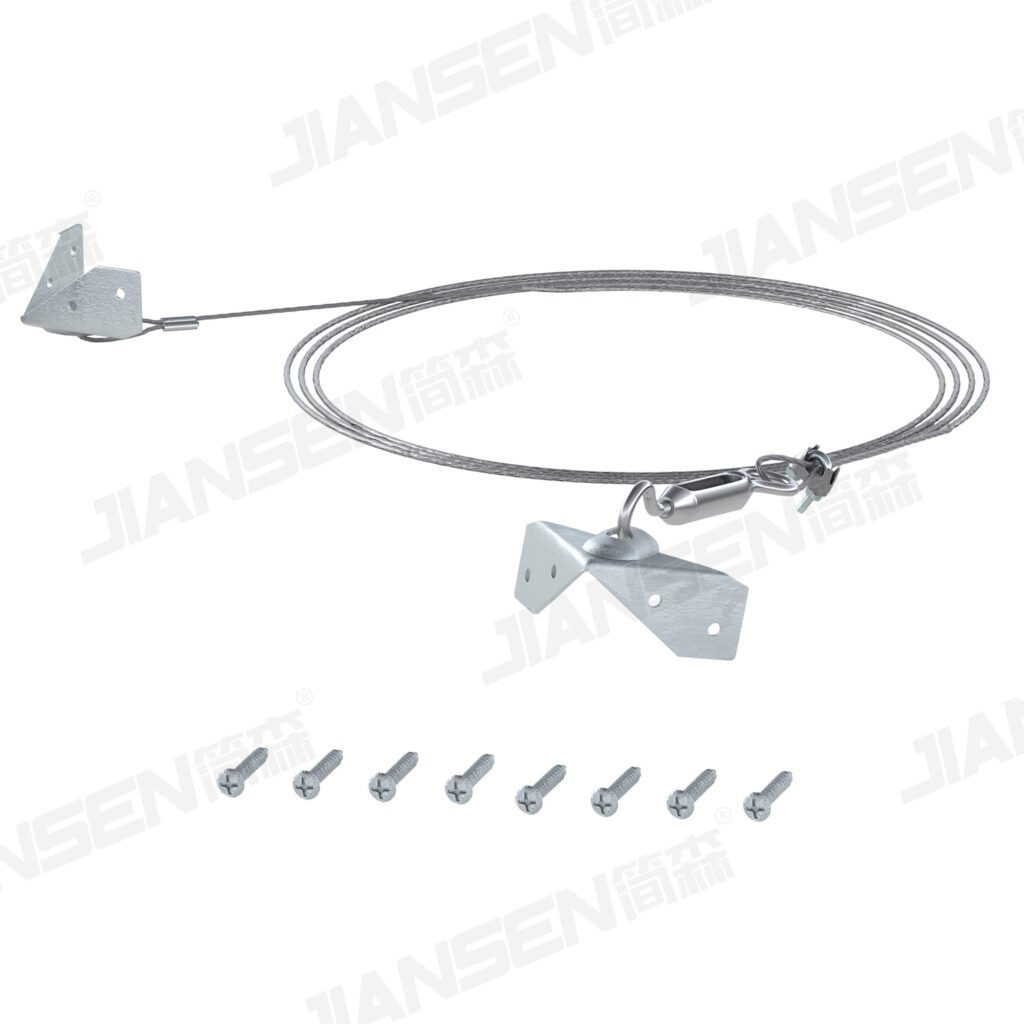
To source an anti-sag gate kit for a wholesale or OEM program, define the complete bill of materials, gate construction, mounting geometry, adjustment method, finish, packaging, and inspection evidence before asking suppliers to quote. Approve an assembled sample on a representative gate, freeze the drawing and component list, and inspect production against that approved reference. A cable kit can help correct or limit racking in a suitably braced gate, but it does not replace sound gate design, secure hinges, or a stable post.
This guide is for importers, distributors, private-label brands, fencing contractors, and hardware buyers. It treats the kit as a packaged system rather than a loose collection of parts. The goal is a repeatable RFQ and acceptance process—not an unsupported performance promise. Jiansen can use this type of specification to review manufacturability and prepare a project-specific quotation.
Define what the anti-sag gate kit must do
An anti-sag cable normally runs diagonally across a gate leaf and uses an adjustment device to bring the frame closer to square. The useful procurement question is not simply “Is the cable strong?” The buyer must ask whether every component, interface, and instruction works with the intended gate. Wood species, frame layout, fastener location, gate width and height, exposure, installation access, and the direction of adjustment can all affect the selected configuration.
Start with a drawing or annotated photograph of the gate. Mark the hinge side, latch side, diagonal cable route, attachment points, available edge distances, and any conflict with infill boards or bracing. State whether the kit is for a new gate, a repair program, a retail replacement package, or a contractor pack. Those use cases can require different fasteners, instructions, labeling, and carton quantities even when the metal components look similar.
Separate the kit function from the gate system
A cable kit applies an adjustable diagonal force. It cannot correct a loose post, damaged hinge fasteners, decayed timber, a flexible frame joint, or an unsuitable hinge arrangement. The supplier should therefore review the kit interface without claiming that the component alone guarantees gate alignment. Final suitability must be confirmed on the buyer’s representative assembly.
Build a complete RFQ before comparing quotations
A useful RFQ gives each supplier the same inputs and requests the same outputs. This prevents a low quotation from hiding omitted screws, a different finish, an underspecified cable termination, or retail packaging that was never included. Attach a revision-controlled drawing and identify any item that remains open for supplier recommendation.
| RFQ field | Buyer input | Supplier evidence requested |
|---|---|---|
| Application | New installation, repair, retail replacement, or contractor pack; indoor or outdoor use | Proposed kit configuration and stated assumptions |
| Gate construction | Frame material, infill, width, height, thickness, hinge side, latch side, and diagonal route | Marked-up interface drawing |
| Component list | Cable, adjustment device, brackets, clamps or terminals, and fasteners | Itemized BOM with material and finish for each part |
| Installation interface | Hole locations, available edge distances, tool access, and substrate details | Installation drawing and instruction draft |
| Adjustment | Required adjustment direction, accessible tool, and field re-adjustment expectation | Demonstration on an assembled sample |
| Appearance | Color, gloss reference, visible surfaces, logo, and label artwork | Approved finish sample and artwork proof |
| Packing | Parts per kit, kits per carton, barcode, language, warning, spare-parts policy | Pack-out sample, carton layout, and packing list |
| Inspection | Critical characteristics, sampling method, defect classes, and release authority | Inspection plan and completed report format |
Do not accept “standard size” as the only dimensional description. Record dimensions and acceptance limits on the drawing used for the order. Likewise, a finish name is not enough: define the substrate preparation, coating system, color reference, appearance criteria, and agreed verification method. If corrosion testing is relevant, the buyer and supplier must agree on the specimen, exposure procedure, evaluation criteria, and acceptance threshold for the specific project.
Verify the BOM as one functional system
The BOM should identify every supplied piece and connect it to the packing artwork. Typical elements include a cable, an adjustment device such as a turnbuckle, attachment brackets or eyes, cable terminations, and installation fasteners. The exact design varies, so the approved BOM—not a generic list—must control production.
Check the cable and end connections
- Confirm cable construction, material designation, finish, cut length, end preparation, and visible damage criteria.
- Verify that swaged, looped, clamped, or threaded terminations match the approved drawing.
- Check for broken strands, sharp ends, incomplete engagement, distortion, and contamination.
- Confirm that installed adjustment remains accessible and does not rub against the frame or infill.
Check the adjustment device
- Record body and end-fitting materials, thread form, usable adjustment range, finish, and locking method.
- Inspect threads with the agreed mating part or gauge and verify smooth engagement through the required range.
- Make the installation instruction show which direction tightens the diagonal and when the installer must stop.
- Require the assembled sample to hold its set position during the buyer-defined functional check.
Check brackets and fasteners
- Identify bracket material, thickness, hole pattern, formed geometry, edge condition, and finish on the controlled drawing.
- Specify the intended substrate for each fastener. A screw selected for wood should not be assumed suitable for a metal frame or hollow composite section.
- Confirm that heads, washers, and tools remain accessible after assembly.
- Inspect for burrs, sharp edges, cracks, blocked holes, missing washers, and mixed finishes.
For an example of a complete kit configuration, buyers can review Jiansen’s Anti-Sag Gate Support Cable Kit product page. For the underlying mechanism and installation orientation, see the site’s anti-sag gate support cable explainer. These links help define the product family; the signed project drawing and approved sample must still control the order.
Approve a representative sample before production
Sample approval should reproduce the intended installation rather than judge loose parts on a desk. Use the actual gate material where practical, or a documented fixture that reproduces the mounting interface. Photograph the starting geometry, install the kit using the proposed instructions, operate the adjustment, and record the final geometry. Note any interference, slipping, coating damage, tool-access problem, or ambiguous instruction.
- Confirm identity: match every component to the drawing, BOM, finish sample, and packaging artwork.
- Inspect before assembly: check visible defects, threads, cable ends, holes, edges, and supplied quantities.
- Install as a customer would: use only the specified tools and included instructions; record deviations.
- Adjust the gate: verify that the mechanism changes the diagonal as intended without binding or damaging adjacent parts.
- Exercise the assembly: open, close, and recheck the gate using a buyer-defined protocol appropriate to the intended application.
- Freeze the approved reference: sign the drawing, BOM, finish sample, instruction, artwork, and sample record with revision identifiers.
Jiansen and the buyer should resolve open points before the production release. A photo approval alone is weak control because it may not show material, finish preparation, thread engagement, cable construction, or what is inside the package.
Create an inspection plan tied to buyer risk
Classify defects before inspection. A critical defect could create an immediate safety concern or make installation unsafe. A major defect could prevent assembly, adjustment, identification, or intended function. A minor defect could be a limited appearance or packaging issue that does not impair use. The buyer must define examples for the specific kit and market.
For lot inspection, buyers may specify an attribute-sampling plan based on ISO 2859-1. The purchase document should name the sampling plan and acceptance criteria rather than using “standard inspection” as shorthand. Sampling never replaces control of critical characteristics or appropriate functional validation.
| Inspection stage | What to verify | Record to retain |
|---|---|---|
| Incoming components | Identity, material records where required, finish, dimensions, threads, and cable-end condition | Receiving record and supplier certificates requested by contract |
| In-process assembly | Correct components, complete termination, usable adjustment, and workmanship | Traveler or process inspection record |
| Finished-kit audit | BOM completeness, appearance, fit on fixture, instructions, labels, and pack-out | Final inspection report with photographs |
| Pre-shipment release | Lot identity, approved revision, carton quantity, marks, documents, and agreed sampling result | Release authorization and packing list |
Use standards as methods, not marketing claims
If coating adhesion is a contractual characteristic, ASTM D3359 describes tape-test methods for rating adhesion of relatively ductile coating films on metallic substrates. It also explains method limitations and operator effects. If a corrosion exposure is requested, ASTM B117 defines the apparatus and conditions for a salt-fog environment, but ASTM states that the practice does not prescribe a product’s exposure period or interpretation. The buyer must define project-specific acceptance criteria rather than treating the method name as a universal performance grade.
A supplier’s quality system can support document control, corrective action, and traceability, but it does not certify a particular kit’s fitness for the buyer’s gate. ISO’s official overview describes ISO 9001 as a quality-management-system standard. Ask for current, verifiable scope evidence when certification is contractually relevant, and separately validate the product requirements.
Control retail and export packaging
A complete product can still fail commercially if one small fastener is missing or the instruction is unclear. Create a pack-out board or photograph that shows every component and quantity. Link the BOM item numbers to the instruction illustrations. Define bag sealing, separation of coated parts, protection of cable ends, barcode content, country-of-origin marking, carton labels, and the method used to prevent mixed revisions.
Run a trial pack and unpack it in the same sequence a customer will follow. Check whether the cable springs out, sharp ends can pierce a bag, loose hardware can abrade coated parts, or the instruction is hidden. If raw-wood pallets or dunnage are used in international trade, review the destination requirements and the official ISPM 15 guidance; processed-wood packaging is treated differently in the standard’s scope.
Use a clear pre-shipment acceptance workflow
- Confirm the purchase order references the approved drawing, BOM, finish reference, artwork, instructions, and inspection plan.
- Verify production and packing records carry the correct revision and lot identity.
- Inspect sampled kits for identity, workmanship, dimensions, finish, thread engagement, cable-end integrity, quantity, and labels.
- Assemble selected kits on the approved fixture and perform the agreed adjustment and functional checks.
- Record every nonconformity with a photograph, defect class, quantity, and disposition.
- Release only after required corrective action, rework verification, and document completion are accepted by the authorized buyer representative.
When requesting a quotation from Jiansen, send the gate drawing, complete BOM expectation, finish and packaging references, inspection plan, destination, order quantity, and required commercial terms. Request a list of supplier assumptions and exceptions with the quotation. That makes commercial comparisons faster and keeps unverified claims out of the specification.
Frequently asked questions
What information should an anti-sag gate kit RFQ include?
Include the gate material and geometry, hinge and latch sides, cable route, attachment interfaces, required components, finish, packaging, artwork, inspection method, destination, quantity, and requested commercial terms. Attach a revision-controlled drawing and ask the supplier to list assumptions and exceptions.
Can an anti-sag cable kit fix every sagging gate?
No. A cable kit can apply adjustable diagonal force to a suitable gate frame, but it cannot repair an unstable post, loose hinge mounting, decayed material, weak joints, or an unsuitable gate design. Inspect the complete gate system before selecting the remedy.
What should be included in an anti-sag gate kit BOM?
The approved BOM should identify the cable, adjustment device, brackets or eyes, cable terminations, fasteners, washers, instructions, labels, and packaging components actually supplied. Each item should link to a drawing or unambiguous specification.
How should a buyer approve an anti-sag gate kit sample?
Match the sample to the BOM and drawing, install it on a representative gate or documented fixture, operate the full adjustment range required by the project, check interference and workmanship, perform the buyer-defined functional check, and sign the complete approval record with revision identifiers.
Which coating checks are relevant to gate-kit procurement?
Define visual criteria, color reference, substrate preparation, coating system, and agreed verification methods. ASTM D3359 can be specified for coating adhesion on appropriate metallic substrates, while ASTM B117 defines a salt-fog test environment. Neither method supplies a universal product acceptance threshold; the buyer must define one for the project.
How should finished anti-sag gate kits be inspected?
Inspect kit identity, BOM completeness, cable and termination condition, threads, brackets, fasteners, dimensions, finish, labels, instructions, and packaging. Include assembly and adjustment checks on an approved fixture, then record defects and disposition under the agreed sampling plan.
What documents should be retained for shipment release?
Retain the purchase order, approved drawing and BOM, finish reference, sample approval, artwork and instructions, material or process evidence required by contract, inspection results, nonconformity dispositions, packing list, and final release authorization.
