
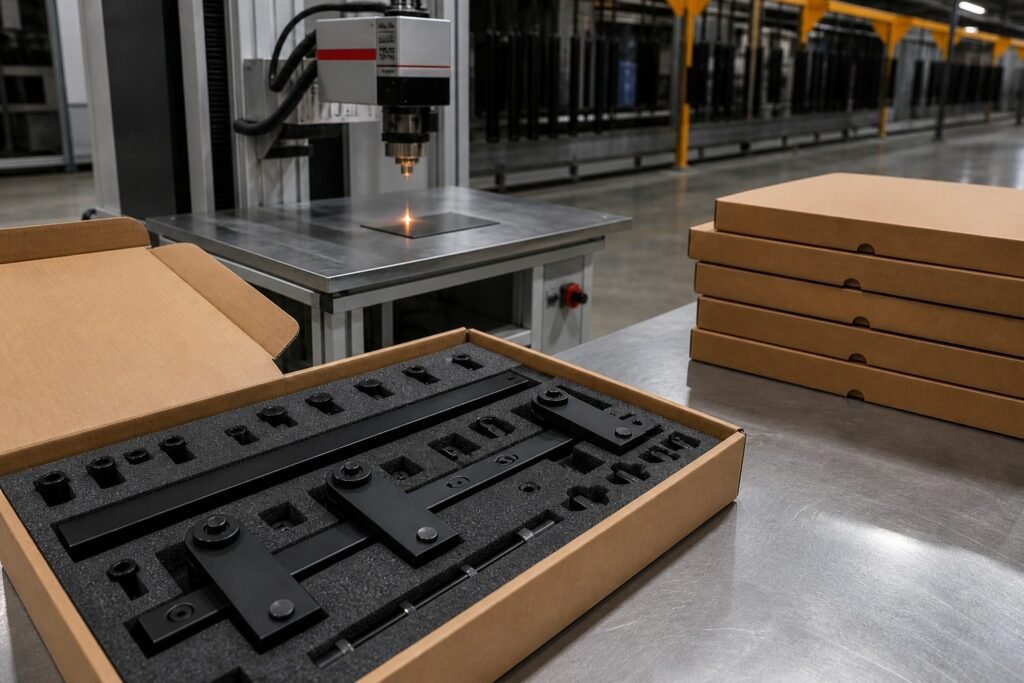
Direct answer: A barn door hardware kit should be sourced as a controlled system, not as a bag of visually similar parts. Give every candidate supplier the same revision-controlled bill of materials (BOM), interface drawing, packaging map, label specification, sampling plan, and receiving checklist. Approve an assembled sample and packed sample before production, then inspect shipments against those references. This approach separates a dependable kit program from a quote that covers only the visible track and rollers.
This guide is for importers, distributors, private-label brands, project buyers, and contract hardware teams. It focuses on purchasing, supplier comparison, packing, quality control, and receiving. It does not assign certifications, load ratings, salt-spray performance, cycle life, tolerances, minimum order quantities, lead times, or prices to Jiansen or any other supplier. Those values must be defined and verified for the actual design, market, and contract.
Define the complete barn door hardware kit before requesting quotes
Start by describing the whole installation. Identify the door construction, wall or support condition, track arrangement, travel direction, available clearance, guide concept, stops, anti-jump devices, and the intended installer. A supplier cannot confirm compatibility from a lifestyle photograph. The RFQ should contain a controlled assembly drawing and identify which components are supplied by the buyer, the hardware factory, or another vendor.
Build a line-by-line BOM. Typical rows include track sections, joining features where applicable, hangers, rollers, stops, anti-jump parts, spacers, mounting fasteners, door fasteners, a floor or wall guide, adjustment tools, decorative caps, instructions, labels, and inner packaging. Do not assume that the phrase “full kit” defines these contents. Link each row to a drawing number, material field, finish reference, quantity per kit, and packing location.
Buyers can review Jiansen’s verified barn door hardware kit category to understand available product families, then use the RFQ to freeze the exact project configuration. A category page supports discovery; the approved BOM controls production.
Record these RFQ fields
| Field | Buyer input | Supplier response or evidence |
|---|---|---|
| Application | Door, support, location, use, installation constraints | Questions, assumptions, compatibility review |
| Configuration | Assembly drawing, part numbers, revision, quantity per kit | Marked-up drawing and confirmed BOM |
| Materials and finish | Required material and controlled appearance reference | Proposed process and sample evidence |
| Interfaces | Hole pattern, clearances, mating parts, tool access | Measurement method and sample assembly record |
| Packaging | Inner packs, separators, carton map, label fields | Packed sample, photos, and packaging specification |
| Inspection | Characteristics, method, frequency, records | Inspection plan and report template |
| Change control | No unapproved substitutions; notification route | Named owner and written change procedure |
Compare suppliers with the same evidence request
A fair comparison requires identical inputs. Issue the same drawing pack and commercial assumptions to every candidate. Ask each supplier to flag missing information instead of filling gaps silently. Normalize quotations to the same scope: included components, packaging, labels, inspection records, tooling responsibility, sample stages, and delivery term. A low unit figure is not comparable if another quote includes more components or a stronger control plan.
Score evidence rather than adjectives. “Quality hardware” is not measurable. A returned drawing, sample-assembly record, finish reference, photographed packing sequence, inspection form, and deviation log can be reviewed. Ask who owns each process, which operations are performed internally or externally, how mixed revisions are prevented, and how a nonconforming component is contained before it enters a kit.
Use a supplier comparison matrix
| Question | Evidence to request | Buyer decision |
|---|---|---|
| Can the supplier control the complete kit? | Process map and BOM responsibility | Accept, clarify, or divide scope |
| Can interfaces be verified? | Measurement method and assembled sample | Approve method or request revision |
| Can finish variation be managed? | Approved visual reference and handling plan | Define acceptance under agreed lighting |
| Can packing prevent contact damage? | Packed sample and transport-test proposal | Approve or redesign protection |
| Can changes be contained? | Revision control and written notification process | Name authorization owner |
Approve fit and assembly before judging appearance
The first sample review should confirm identity and interfaces. Verify the track and hanger relationship, stop engagement, anti-jump placement, guide compatibility, spacer arrangement, fastener access, and the installation sequence. Assemble the sample using the intended instructions and representative mating components. Record any rework, extra tools, ambiguity, or interference. A sample that works only after an experienced engineer improvises is not ready for a retail or contractor kit.
Do not convert a sample result into a universal performance claim. If a project requires a declared load, operating cycle, corrosion exposure, or other performance criterion, the buyer and qualified technical parties should define the test setup, sample condition, pass/fail rule, and report requirement. The supplier’s evidence must identify the tested configuration; it should not be generalized to untested variants.
For specific variants, the verified stainless steel barn door hardware category can help buyers map candidate SKUs. Material names alone do not prove suitability; the RFQ and sample approval remain controlling.
Design packaging around the damage path
Barn door hardware kits combine long metal parts, rolling components, small fasteners, and finished surfaces. That creates several predictable packaging risks: hard parts rubbing a visible finish, fasteners escaping an inner bag, heavy pieces shifting inside a carton, labels separating from the correct revision, and similar components being mixed at the packing station. Address each risk in the packaging specification rather than relying on the phrase “export packing.”
Create a packaging map that shows the location and orientation of every component. Define separators, sleeves, bags, ties, caps, and protective layers by function. Keep loose fasteners from contacting finished faces. Make installation instructions visible when the carton opens. Use component or inner-pack identifiers where visually similar parts can be confused. Carton labels should connect the product code, revision, quantity, and buyer reference without exposing data that the buyer does not want on retail packaging.
If wood packaging material is used in international logistics, review the destination requirements and the official IPPC ISPM 15 text with the logistics provider. That source governs wood packaging treatment and marking; it does not certify a particular shipment. For barcode implementation, use the current GS1 barcode guidance and validate the buyer’s data structure and scanning environment.
Validate the packed sample
- Photograph each packing layer and record the approved revision.
- Count every BOM line and verify the correct inner-pack label.
- Check that metal-to-metal contact cannot occur during normal handling.
- Confirm carton dimensions and orientation against the packing map.
- Scan labels with the intended workflow rather than checking appearance only.
- Open and reassemble a packed sample to verify instructions and part identification.
- Define transport evaluation with the packaging engineer or logistics partner for the actual distribution route.
Build an inspection plan that follows the BOM
The inspection plan should name the characteristic, method, instrument or reference, sampling rule, responsible party, and record. Separate identity checks, dimensional interfaces, functional assembly, visual finish, packaging, and labeling. This prevents a general “passed QC” statement from hiding an incomplete inspection.
For sampling, ISO 2859-1 describes acceptance sampling procedures by attributes. Referencing the standard does not automatically select a sample size or acceptance criterion. The purchase agreement must define the lot, inspection level, acceptance quality limit where used, switching rules, and handling of nonconforming results. A buyer may require different controls for safety-relevant interfaces, appearance, contents, and packaging.
Use this pre-shipment QC checklist
- Identity: Match purchase order, SKU, drawing revision, BOM revision, and approved sample.
- BOM completeness: Count each component and confirm variant, handedness, and finish.
- Critical interfaces: Measure only against approved drawings and record actual results.
- Assembly: Build the defined sample configuration using production instructions and packed tools.
- Function: Check travel, stop, anti-jump, guide, and adjustment behavior under the agreed setup.
- Appearance: Compare visible surfaces with the approved reference under agreed viewing conditions.
- Fasteners: Verify type, count, segregation, identification, and installation access.
- Packaging: Compare each layer with the signed packing map and check contact protection.
- Labels and instructions: Verify SKU, revision, buyer data, scan result, language, and document version.
- Records: Attach photographs, measurements, sample identity, inspector, date, and disposition.
Control nonconformities and supplier changes
Define what happens when inspection finds a mismatch. The supplier should identify affected lots, stop further mixing, segregate suspect material, document the condition, and request disposition. Rework must use an approved instruction and be re-inspected. The buyer should decide whether replacement, rework, concession, or rejection is appropriate; the supplier should not silently substitute components or repair visible finishes.
Change control is equally important. Require written approval before changes to materials, sub-suppliers, tooling, processes, drawings, packaging, labels, or manufacturing location when those changes can affect the agreed product. Update the master sample and documents together. Jiansen can review a project-specific RFQ and return manufacturability questions, but final acceptance criteria belong in the controlled buyer-supplier specification.
Perform receiving inspection without reopening every decision
Receiving teams need a short check tied to the approved records. Verify shipment and revision identity, carton condition, label readability, unit count, sampled BOM completeness, visible finish condition, critical fit interfaces, fastener segregation, and instruction version. Record discrepancies with carton, batch, and sample identifiers. Do not blend suspect cartons into available stock before disposition.
Use supplier pre-shipment evidence to focus receiving work, not eliminate it. A stable history may support a different agreed sampling approach, while new or changed configurations may justify closer review. Purchasing, quality, warehouse, and product teams should share one revision source so that an old drawing does not become the receiving standard.
Turn the requirements into an RFQ release package
Before sending the RFQ, assemble one controlled package: application brief, assembly drawing, part drawings, BOM, finish reference, packaging map, label artwork, instruction draft, inspection plan, sample approval form, and change-control requirement. State open questions explicitly. Ask suppliers to return a compliance matrix showing “confirmed,” “deviation,” or “question” for every requirement.
Before production release, close the following gates:
- Commercial scope matches the technical BOM and packaging scope.
- Drawings and BOM share the same approved revision.
- Representative fit and assembly are approved.
- Finish and visual references are signed and traceable.
- Packed sample, labels, and instructions are approved.
- Inspection and sampling rules are written in the purchase agreement.
- Open deviations have named owners and written disposition.
- Change notification and nonconformance routes are confirmed.
The practical result is not a generic “best supplier” claim. It is a repeatable evidence chain from inquiry to receiving. That is how a buyer makes a barn door hardware kit comparable, inspectable, and less vulnerable to missing parts, mixed revisions, installation confusion, or packaging damage.
Frequently asked questions
What should a barn door hardware kit RFQ include?
Include the controlled drawing revision, complete BOM, material and finish fields, mating-door assumptions, packaging map, label data, sample plan, inspection records, and rules for substitutions or changes.
How should buyers compare barn door hardware suppliers?
Send every supplier the same revision-controlled RFQ and compare returned evidence for component traceability, sample assembly, inspection methods, packaging validation, nonconformance handling, and change control—not price alone.
Which parts should be checked before a barn door hardware kit is packed?
Check the track sections, hangers, rollers, stops, anti-jump devices, floor guide, spacers, fasteners, tools, instructions, and any project-specific accessories against the approved BOM and packing map.
How can a buyer prevent mixed or missing kit components?
Use a photographed packing standard, component-level identification, a count-and-scan step, sealed inner packs, carton labels tied to the SKU and revision, and a final weight or contents check validated during sampling.
What should incoming inspection cover?
Verify purchase order and revision identity, carton and label condition, unit count, BOM completeness, visible finish condition, critical fit interfaces, fastener segregation, instruction version, and retained evidence for any nonconformance.
How should sampling levels be chosen?
Choose sampling rules in the purchase agreement according to shipment risk, defect history, inspection cost, and customer requirements. ISO 2859-1 can provide a framework, but the parties must agree the lot definition and acceptance parameters.
What evidence should be approved before mass production?
Approve a representative assembled sample, signed drawings, BOM, finish reference, packaging sample, label artwork, inspection plan, and written disposition of open issues before authorizing production.
Conclusion
Source barn door hardware kits by controlling the system: define every component and interface, compare suppliers on the same evidence, approve assembly and packaging samples, inspect against the BOM, and keep revisions synchronized through receiving. Use external standards as frameworks only where they fit the contract, and write project-specific acceptance criteria instead of relying on unsupported claims.
