
Short answer: In the US, a pool gate is not a normal fence gate. CPSC Publication 362 and the International Swimming Pool and Spa Code (ISPSC) require pool gates to be self-closing and self-latching, with the latch release positioned high enough that a young child cannot reach it, and the gate swinging outward, away from the pool. Wholesalers and fencing contractors should source hardware that demonstrably delivers these three behaviors: adjustable-tension self-closing hinges, self-latching latches rated for outdoor corrosion, and documentation a code official will accept. Jiansen Hardware manufactures these components with published wholesale terms — samples from 1 set, 15–30 day lead times, FOB Ningbo, and US warehouse stock for urgent replenishment.
Why Pool Gates Are a Different Hardware Category
Drowning is the leading cause of death for children ages 1–4 in the United States, and most incidents happen in residential pools. That is why barrier requirements are written into consumer safety guidance (CPSC Publication 362, Safety Barriers for Home Pools) and into enforceable model codes such as the ISPSC, which states including Florida adopt or extend.
The barrier rules that directly drive hardware specifications:
| Barrier requirement (CPSC 362 / ISPSC) | What it means for the gate |
|---|---|
| Fence around the pool at least 48″ high | Hardware must support tall, heavy gate leaves without sag |
| Gate must be self-closing | Spring or hydraulic hinge that returns the gate from any open position |
| Gate must be self-latching | Latch must catch automatically when the gate closes — no manual flip |
| Latch release out of a child’s reach (typically 54″ above grade on the pool side) | Latch body and release mechanism must mount high and operate reliably at that height |
| Gate swings outward, away from the pool | Hinge handedness and hinge stop configuration must match outward swing |
| No climbable features near the barrier | Hardware profile should not add climbable protrusions |
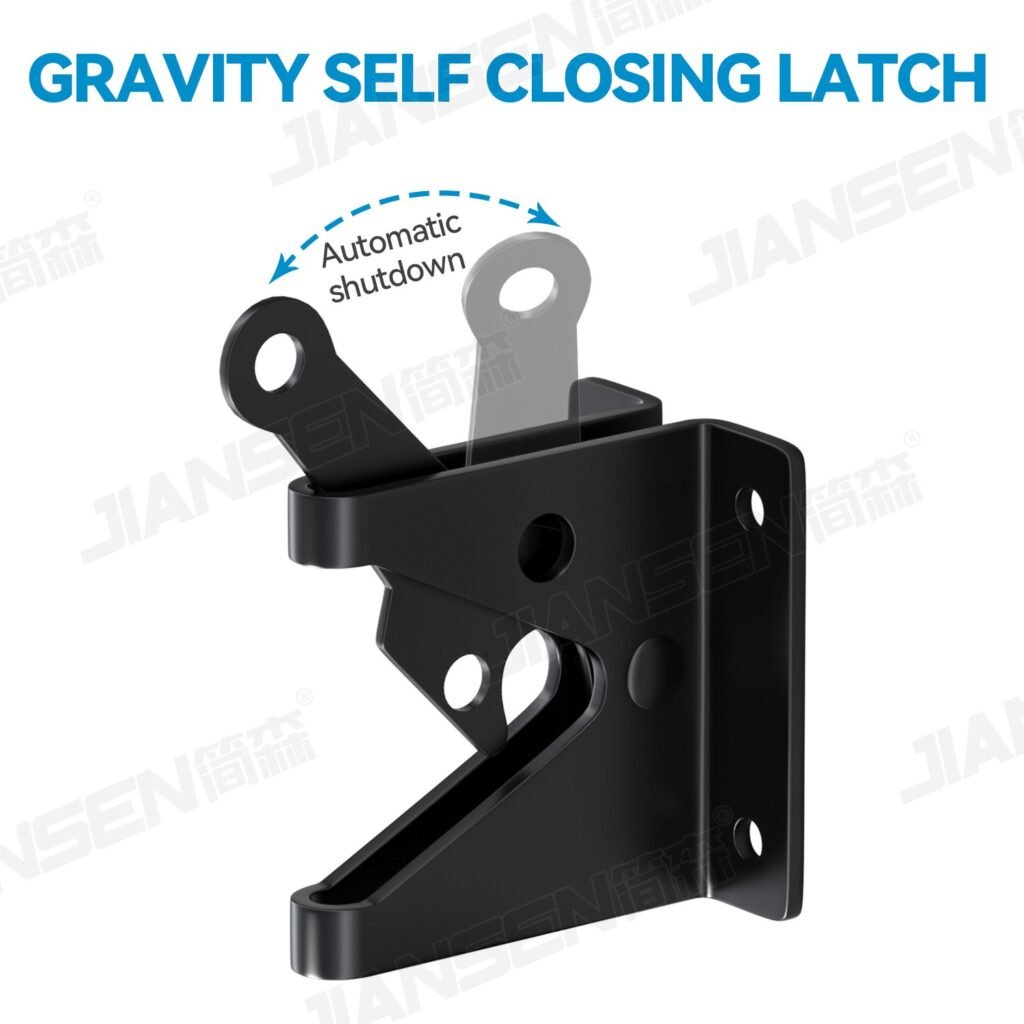
A standard gravity-drop gate latch or a free-swinging butt hinge cannot meet these rules. That is the entire sourcing problem: the mechanism set, not the price, is what a code inspector checks.
Translating Code Requirements Into a Hardware Spec Sheet
Use this mapping when requesting quotations — it forces suppliers to answer on the points that matter:
| Requirement | Hardware feature to specify | Question for the supplier |
|---|---|---|
| Self-closing from any position | Adjustable-tension self-closing hinge (spring or polymer) | What is the tested cycle life? Is spring tension adjustable after installation? |
| Self-latching | Spring-loaded self-latching latch, lockable option | Does the latch engage at low closing speed (under-closing)? |
| Child-unreachable release | Latch designed for 54″ mounting; pull-cable or padlock option | Show the mounting diagram at 54″ with the release geometry |
| Corrosion resistance | Stainless 316/304, hot-dip galvanized or marine-grade polymer | Salt-spray test hours? Which finish for coastal/saltwater pools? |
| No climb aids | Low-profile design, no exposed lever loops | Provide dimensioned drawings, not just photos |
Material Selection for Pool Environments
Pool hardware lives in chlorinated air, splashed chemicals and, in coastal installs, salt fog. Finish failure here means rust complaints from the end customer within one or two seasons:
- Stainless steel 316 — best for saltwater pools and coastal sites; the grade to quote by default for premium tiers.
- Stainless steel 304 — standard choice for freshwater residential pools; the volume workhorse.
- Powder-coated carbon steel — acceptable for inland, budget segments if the coating passes extended salt-spray testing; specify coating thickness and test hours in the PO.
- Engineered polymer/nylon components — self-closing hinges and latches built around reinforced polymer bodies eliminate corrosion entirely and are increasingly specified in PVC/vinyl pool fence systems.
When comparing factory quotes, the finish grade is the first number to normalize — a quote for 304 cannot be compared against a 316 quote line by line.
Wholesale Sourcing Checklist
For distributors and fencing contractors buying pool gate hardware in volume:
- Ask for mechanism test reports. Cycle counts for the self-closing hinge and engagement tests for the latch at low closing speed. A factory that cannot produce these usually does not run them.
- Verify the latch works at 54″ mounting height. Some latch bodies are designed for mid-gate mounting and bind or misalign when mounted high with a pull-cable.
- Demand sample sets before volume orders. Reputable factories release samples from 1 set — Jiansen’s sample policy starts at one set, with production MOQ quoted per SKU.
- Lock in lead-time realism. Standard orders run 15–30 days production; large-volume or OEM work 30–45 days. Quotes far below that for custom finishes deserve skepticism.
- Plan replenishment. If the supplier holds US warehouse stock, emergency restocks ship domestically instead of by ocean — Jiansen keeps 200+ SKUs stocked in California for exactly this scenario.
- Get documentation buyers can hand to inspectors. Material grade declarations and finish test reports convert a product sale into a spec-in sale.
FAQ
What standard governs pool gate hardware in the US?
The barrier requirements come from CPSC Publication 362 (Safety Barriers for Home Pools) and are codified in model codes like the ISPSC, which many states adopt. Hardware itself is not “certified” as a single standard — it must demonstrably deliver self-closing, self-latching and child-resistant release behavior that the barrier rules require.
Can a regular gate latch be used on a pool gate?
No. A pool gate needs a self-latching mechanism that engages automatically at low closing speed, mounted so the release is out of a young child’s reach. Gravity latches and standard bolt latches do not meet these requirements.
Which stainless grade is right for pool gate hardware?
316 for saltwater pools and coastal locations; 304 for standard freshwater residential pools. Specify the grade on the purchase order and request salt-spray test data for coated alternatives.
What should a fencing contractor test on a sample gate before bulk ordering?
Close the gate slowly from 10–15° and confirm the self-closing hinge still returns it fully and the latch engages. Cycle the mechanism 200+ times on the sample, check tension adjustment, and verify the latch mounts cleanly at 54″.
What MOQ and lead time should I expect for pool gate hardware from a Chinese factory?
Samples from 1 set for evaluation, trial orders carton-based, production MOQ quoted per SKU; production 15–30 days for standard orders and 30–45 days for large-volume or OEM, FOB Ningbo as the default trade term.
Do pool gate hardware suppliers need to provide compliance documents?
There is no single “pool hardware certificate,” but material grade declarations, salt-spray/finish test reports and mechanism cycle-test data are what inspectors, pool builders and distributors ask for. Suppliers that publish these win spec-in business.
Sources
- U.S. Consumer Product Safety Commission, Safety Barriers for Home Pools (CPSC Publication 362) — cpsc.gov
- International Swimming Pool and Spa Code (ISPSC) — model pool barrier provisions
- Related: how to verify a Chinese hardware supplier · MOQ, lead time & shipping guide · fence & gate hardware catalog
