A qualified fence gate hardware supplier should help a buyer specify a coordinated gate system, not simply quote isolated hinges or latches. For an OEM or wholesale order, define the gate construction, finished dimensions and mass, operating frequency, exposure environment, hinge and latch functions, mounting interface, finish, fasteners, packaging, and inspection plan before requesting a price. This specification-first approach makes quotations comparable and reduces the risk of receiving components that look suitable but do not work together on the intended gate.
Start with the complete assembly. A gate leaf, post, hinges, latch, drop rod, fasteners, reinforcement, and closing device interact as one system. A product name such as “heavy-duty hinge” or “outdoor latch” is not a shared engineering rating. The RFQ should therefore describe the actual gate and identify which requirements must be verified by drawing, sample, inspection, or project-specific testing.
| RFQ field | Buyer input | Supplier output to request |
|---|---|---|
| Gate construction | Wood, steel, aluminum, vinyl/composite, or chain link; identify frame and infill separately | Recommended mounting interface, reinforcement assumptions, and compatible component family |
| Gate geometry | Finished width, height, thickness, measured mass, clearances, hinge spacing, and swing direction | Drawing review, hinge arrangement, latch location, and any unresolved fit questions |
| Operating duty | Average and peak openings, expected impact or misuse, closing requirement, and maintenance access | Mechanism proposal, wear-part plan, and representative-gate validation method |
| Exposure | Indoor, ordinary outdoor, wet, coastal/chloride, industrial, chemical-cleaning, or freeze-thaw conditions | Material and finish proposal covering bodies, pins, springs, washers, fasteners, and repair method |
| Security and control | Manual, lockable, self-latching, double-gate, drop-rod, access-control, or other functional need | Coordinated hinge/latch/bolt set and a clear statement of what is and is not included |
| Commercial package | Order quantity, destination market, labeling language, barcode data, carton marks, manuals, and set configuration | Quotation version, packing proposal, sample route, production plan, and revision-controlled BOM |
Missing gate weight, incomplete hole patterns, an undefined finish, and unclear packaging frequently force a supplier to make assumptions. A photo alone cannot establish the structural frame, reinforcement, mounting substrate, or fastener access. Send a dimensioned gate drawing when possible. If the design is not final, mark open fields and ask the supplier to return a list of assumptions rather than embedding them silently in the quote.
The appropriate set depends on the gate type and operating objective. Hinges carry and guide the moving leaf; a latch holds it in the closed position; a cane bolt or drop rod can secure an inactive leaf; and a self-closing mechanism provides return force. These functions must be reviewed together. A stronger spring, for example, does not correct a misaligned latch, a flexible post, or inadequate gate reinforcement.
Compare hinge geometry, mounting method, material, complete finish stack, pin or bearing construction, adjustment method, hole pattern, and fastener compatibility. Gate width affects leverage, while frame stiffness and hinge spacing affect load transfer. Do not assign a maximum gate size from a marketing label. Use the exact SKU drawing, approved sample, and applicable performance record for the proposed installation. The detailed fence hinge selection and OEM sourcing guide provides a separate technical decision matrix for tee, strap, self-closing, adjustable, weld-on, and bolt-on formats.
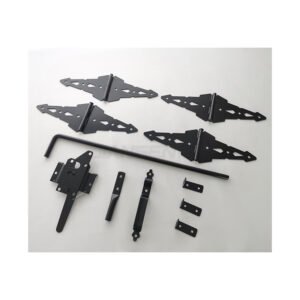
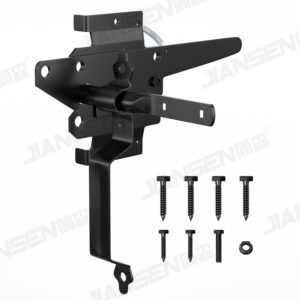
Define the desired closed position, clearances, swing direction, latch engagement, user action, and whether the gate must return automatically. Validate the hinge and latch on a representative gate because alignment, wind, spring setting, gate movement, and latch resistance all influence reliable closure. Buyers comparing a component route can review the JL1904 fence gate latch, while buyers planning a coordinated wood-gate pack can use the JL2234 fence gate hardware kit as an RFQ starting point. Product pages are starting references; the approved quotation and BOM control the actual order.
Double gates and selected large gates may require an inactive leaf to be restrained before the active leaf latches. Specify ground or receiver conditions, rod travel, clearances, corrosion exposure, handle access, and how the receiver will be kept free of debris. The JL1910 cane bolt illustrates this component category, but final dimensions, fasteners, and installation geometry must follow the quoted SKU and approved drawing.
Choose the material and finish as a system. Coated carbon steel can be commercially effective when surface preparation, coating coverage, edges, weld zones, packaging, installation damage, and maintenance are controlled. Stainless options can reduce reliance on an applied coating for basic corrosion resistance, but every exposed component—not only the visible body—must be specified. Pins, springs, washers, and fasteners can become the weak interface if their material is omitted.
Describe the actual environment instead of requesting a color such as “black” or a vague phrase such as “weatherproof.” Rainfall, standing water, chlorides, cleaning chemicals, fertilizers, industrial contamination, UV exposure, crevices, and dissimilar-metal contact can change the required system. If accelerated corrosion testing is part of the project, define the method, sample condition, duration, evaluation criteria, and report format in advance. ISO 9227:2022 specifies salt-spray test procedures, while ASTM B117 covers operation of salt-spray apparatus. Neither source, by itself, assigns a universal service life to a gate-hardware product.
Use a controlled sample process rather than approving appearance from photographs. The buyer and supplier should identify the quotation revision, drawing revision, BOM, material and finish route, packaging version, and sample ID. The sample should represent the intended production configuration or clearly state every deviation.
Jiansen can review drawings, packaging requirements, and component combinations during the RFQ and sampling process. Approval should still be tied to the documented order configuration; a prior sample for another finish or pack should not automatically approve a new version.
Create an inspection plan from the product risk, not from a generic checklist. Typical checkpoints include identity and quantity, critical dimensions, hole position, functional assembly, fastener and accessory completeness, finish appearance, labeling, packaging, and carton marks. Define the measuring method and acceptance rule for each critical characteristic.
For lot-by-lot attribute inspection, buyers may use an agreed sampling framework such as ISO 2859-1:2026. Referencing the standard is not enough: the purchase agreement should state the inspection level, lot definition, acceptance quality limits where applicable, defect classes, and disposition process. Critical fit or safety-related characteristics may require different controls from cosmetic defects.
Private-label packaging must be treated as part of the product specification. State whether each retail or trade pack contains a hinge pair, latch, handle, drop rod, fasteners, instructions, or other accessories. Define bag or box format, protective separation, label location, barcode data, destination-language requirements, carton marks, and document placement. Ask the supplier to return a packing BOM and artwork proof before mass packing.
Jiansen product pages describe options such as labels, cartons, manuals, and alternative retail-pack formats for selected items. Availability must be confirmed for the chosen SKU, order quantity, artwork, and packing route. Do not assume that every listed packaging option is available for every product without a current quotation.
A complete RFQ lets a fence gate hardware supplier identify technical gaps before quoting. Jiansen recommends confirming the drawing, BOM, representative assembly, finish evidence, and packaging proof as controlled order outputs rather than relying on catalog wording alone.
Send the gate and post construction, finished dimensions and mass, swing direction, clearances, operating frequency, exposure environment, required hinge and latch functions, mounting method, finish, order quantity, packaging, destination market, and inspection requirements. Include a dimensioned drawing when available.
Choose a coordinated kit when its hinge, latch, drop rod, fasteners, and packaging match the gate and sales program. Choose separate components when the gate geometry, security function, finish, or pack requires a custom combination. In both cases, approve the exact BOM and sample.
There is no universal best finish. The choice depends on substrate, coating preparation and coverage, chloride or chemical exposure, water retention, fastener compatibility, installation damage, and maintenance. Define the environment and request evidence for the exact quoted configuration.
Selected products can be discussed with custom labels, cartons, manuals, logos, and set configurations. Confirm availability, artwork, barcode data, destination language, protective materials, carton marks, and packing BOM for the chosen SKU and current order.
Approve a revision-controlled drawing, BOM, and representative sample, then use an agreed inspection plan covering identity, critical dimensions, assembly function, finish, accessory completeness, labeling, and packaging. Define defect classes, sampling, acceptance rules, and disposition before production.
MOQ and lead time vary by SKU, customization, tooling, finish, packaging, quantity, material availability, and current capacity. Provide the complete RFQ so the quotation can state the applicable commercial terms and production schedule for that configuration.
Jiansen supplies fence and gate hardware — hinges, latches, drop rods, cane bolts, and related gate components — for OEM and wholesale fence programs, distributors, and project buyers.
Whether you are building a new wooden gate or upgrading an existing fence system, hardware selection should be confirmed against the exact SKU drawing, BOM, and approved sample rather than catalog wording. Explore our wood gate hardware kit options and related wood fence hardware kit configurations as an RFQ starting point.
Core Applications:
Residential / villa perimeter fencing
Community / property-management access gates
Farm / ranch livestock enclosures
Industrial and warehouse access gates
Specification and confirmation:
Configuration: Gate construction, finished dimensions and mass, hinge spacing and swing, mounting interface, and intended operating duty are confirmed against the exact SKU drawing, BOM, and approved sample.
Environment and finish: Exposure conditions, the required material and finish system, and the fastener and backing details are confirmed per item and per approved sample.
Capacity, corrosion and compliance: Load capacity, corrosion performance, and any certification or compliance statement are provided only for the exact tested configuration, supported by the applicable drawing, BOM, report, or certificate.
Commercial terms: MOQ, lead time, and packaging are confirmed against the current quotation for the selected SKU, finish, and order quantity.
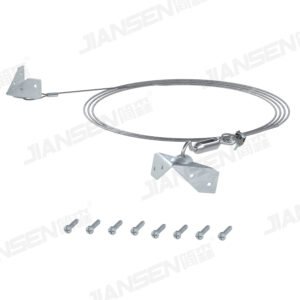


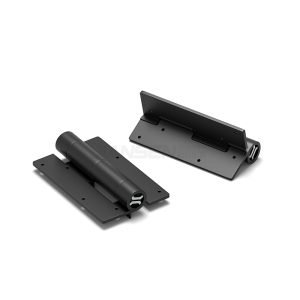


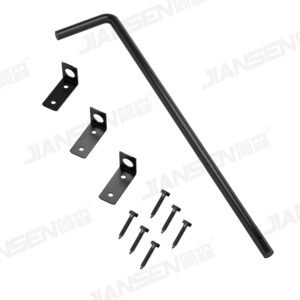


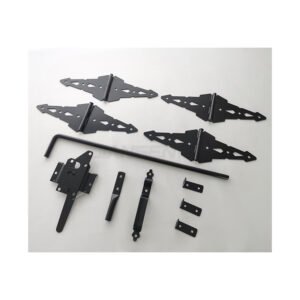
Buying Fence Hardware in volume? Get factory-direct wholesale pricing and lead times.
Get Wholesale Price →
Founded in 2004, Hangzhou Jiansen Hardware specializes in hardware manufacturing, including doors, furniture, fences, etc. Winning the market with quality and service, we continuously innovate while ensuring environmental responsibility and employee well-being, striving for excellence into the future.
© 2026 Hangzhou Jiansen Hardware Co.,Ltd