
Article Summary:
Installing wooden fence gate hardware correctly is crucial to ensuring the long term stability of the gate, its smooth operation, and the safety of the structure.
Incorrectly placed hardware and distribution of loads are both common causes of early gate sagging and failure of the hinge. Additionally, the selection of hardware and the method of installation must be contingent on the weight of the gate, the species of wood, and the environmental exposure.
Introduction: Why proper wooden fence gate hardware installation matters
A wooden gate that is structurally weak is often the most popular component of a fence system; however, it is also the most frequently used.
From a commercial perspective, especially for contractors, fence manufacturers, and B2B hardware suppliers, the installation of hardware is not considered a cosmetic endeavor, but rather a structural one. The correct installation of a product directly affects its safety, lifespan, and customer satisfaction.
What is wooden fence gate hardware?
Wooden fence gate hardware is the plural of metal components that enable a wooden gate to open, close, latch, and maintain its position over time. These components are designed to support weight, weather resistance, and allow wood to move.
Typical hardware for wooden fences includes:
Hinges (strap, T, buckle, or variable)
Latches and catches
Crude or prepared
Screws, bolts, and fasteners
Gate wheels or supports (recommended)
Each component has a mechanical role, and the improper installation of one component can lead to the entire system being compromised.

Understanding gate load and movement before installation
Before installing any wooden hardware for a fence, it’s important to understand how a gate will respond to pressure. Wood’s Gate’s Experience:
Vertical load due to the weight of the gate.
Laterality of stress during the opening and closing process.
Seasonal uplift and drop in temperature due to humidity
The movement of wood is intrinsic and must be permitted rather than opposed. The placement of hardware that ignores these principles often results in hinge pull-out, post rotation, or gate sagging.
How to install wooden fence gate hardware?
Step 1: Selecting the appropriate wooden fence hardware.
Correspond the hardware to the size and weight of the gate.
The top-ranking guides on Google consistently advocate that the hardware selected must be compatible with the gate’s dimensions. Lightweight decorative doors can utilize standard T-hinges; however, heavy privacy doors require additional straps or adjustable hinges in order to distribute the load.
A common professional rule is that the hinge length should be at least one-third of the gate’s width; this rule extends the load to a greater depth in the frame of the gate.
Select materials that are resistant to corrosion.
The hardware for the outdoor wooden fence should be composed of:
Hot-dip galvanized steel
Stainless steel
Coated steel with powder
These coating options block the corrosion and staining associated with pressure-treated wood.
Step 2: Preparing the gate post appropriately
Why are the gate’s posts more important than the gate itself?
Industry experts concur that posts that fail frequently are typically caused by the post, rather than the gate. A post that is weak or misaligned cannot support the appropriate amount of hardware.
The posts at the Gate should be:
More expansive than the fence’s posts in diameter.
Lower than expected
Supported in concrete as necessary
For tall or heavier gates, many contractors increase the post’s depth by 25-30% compared to the standard post.
Step 3: Dispositioning hardware in an accurate manner
Identifying the appropriate hinge positions
Effective design promotes even distribution of loads. Hinges should be positioned near the top and bottom rails of the gate’s frame, never at random.
The highest ranking installers recommend that you dry-fit the hardware and mark the locations of the screws before drilling to avoid splitting and misalignment.
Step 4: Installing hinges on the gate
Pre-drilling and quickening
Pre-drilling the pilot holes decreases the splitting of wood and ensures that the fasteners are placed in the proper position. Structural screws or carousel bolts are more popular than standard wooden screws for heavy doors.
When installing wooden fence gate components, experts often prefasten hinges to the gate first and then attach the gate to the post.
Step 5: hanging the gate and adjusting the position
Maintaining the necessary clearance space.
Adequate clearance on the ground prevents binding due to soil movement or trash. Many experts advise 2–3 inches of extra space, depending on the terrain.
Adjustable hinges are particularly significant for fine-tuning the alignment of the gate after it’s been hung, a feature that is emphasized in many of the most prominent articles.
Step 6: Installing fasteners and securing hardware
Corresponding to the height of the latch and the amount of engagement.
The catch should naturally align without forcing the gate into position. For privacy or security concerns, dual-sided latches or a system that can be locked are necessary.
Latches should be installed that will account for the future sag by being positioned a bit higher than the ideal placement.
Step 7: Include supplementary hardware for heavier doors
When to employ drop ropes or gatewheels
For large or heavier doors, extra hardware for the fence, such as drop ropes or wheels, reduces the stress on the hinges and posts.
These components are typically found in agricultural, commercial, and industrial security systems.
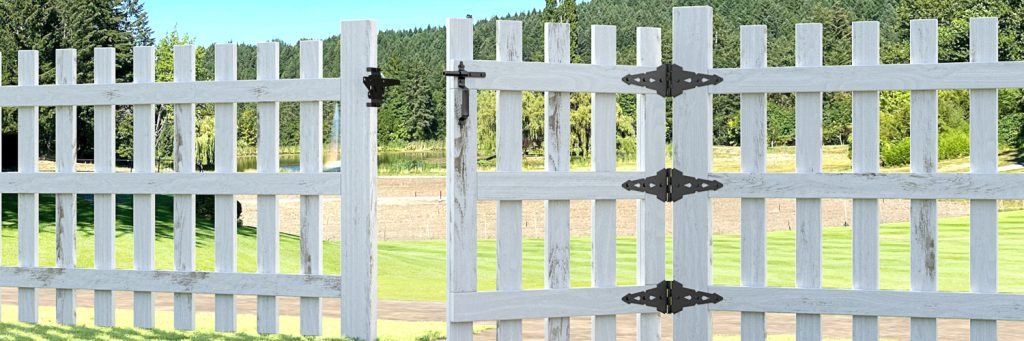
Common mistakes when installing wooden fence gate hardware
Installing wooden fence gate components may seem simple, but small errors can lead to sagging gates, misplacement, early wear, and safety concerns. Understanding the common errors below will help to ensure long-term success and long-lasting performance.
- Selecting the Wrong Device for Gate Diameter and Mass
One of the most common errors is using hardware that is not appropriate for the gate’s weight or dimensions.
Troublesome issues:
Hinges that bend or pull out
The gate’s sagging frequency over time
Lowered hardware efficiency
Best example:
Always check the load capacity and select heavy-duty hinges for wide or solid wooden doors.
- Incorrect Hinge Pointing
Incorrect hinge placement hurts both movement and stability.
Frequent errors include:
Hinges positioned too close to one another.
Hinges that are not oriented vertically.
The top hinge is positioned too low.
Best example:
Close the top hinge to the top of the gate and place the space hinges in a uniform distribution to equalize weight.
- Not taking into account Wood’s Expansion and Contraction
Wood will expand and contract in response to temperature and humidity changes.
Consequences:
Fastening or adhering toggles
Hardware relaxing
The wood around the fasteners is rotten
Best example:
Leave enough space for clearance and avoid over-tightening the screws during installation.
- Employing Incorrect or Low-quality Fasteners
Common screws or interior fasteners are often unable to withstand the outdoors.
Concerns:
Rust and corrosion
Heads that are stripped of their screws
Structural flaw
Best example:
Use stainless steel or galvanized fasteners that are intended for external application.
- Ignoring the stability of the Gate Post
Even superior hardware is unable to remedy a faulty post.
Common errors:
Posts that are not deep enough
insufficient concrete foundation
Posts that are not perfectly level.
Best example:
Ensure posts are solid, flat, and have sufficient anchoring before installing hardware.
- Incorrectly situated Latch and a matched pair of keys
Poor alignment causes the gates to be difficult to close and increases wear.
Typical issues:
Latches that are forced to activate
Locks that are inconsistent in their alignment.
Excessive tension on the hinges.
Best example:
Test the gate’s motion before completing the final tightening and make sure the latch is positioned correctly.
- Avoiding the Corrosion Protection
Failure to safeguard hardware during installation is a cause of early failure.
Risks include:
The development of rust at the edge of the cut material
Complete failure
Decreased aesthetic value
Best example:
Cover exposed metal surfaces with protective coating or sealant. After installation, do this.
- Overlooking the Gate Support Solution
Large or heavier doors necessitate additional assistance.
Mistakes include:
Not using a car lift or cable support
It depend ssolely on hinges
Disregarding the long-term viability of sagging projects
Best example:
Use struts, supports, or wheels to assist with the wide wooden doors.
Table: Wooden fence gate hardware components and functions
| Hardware Component | Primary Function | Installation Consideration |
| Strap hinge | Weight distribution | Length proportional to gate width |
| Adjustable hinge | Fine alignment | Allows post-install correction |
| Gate latch | Secure closure | Must align without force |
| Drop rod | Vertical stabilization | Used on large double gates |
| Gate wheel | Load reduction | For heavy or wide gates |
Maintenance tips after installation
- Complete a first post-installation audit
Within the first few weeks:
Re-tighten the hinges, screws, and bolts.
Check the alignment of the check and the release of the swing.
Ensure that the latches are able to slide into position smoothly.
Wood typically decomposes, which is why early alterations are necessary to prevent long-term issues.
- Frequentally lubricate the moving parts
Use weather-resistant oils to lubricate hinges, latches, and rollers.
Use a spray of silicone or a light machine oil to have a smooth experience.
Avoid dense grease that attracts dirt.
Lubrication decreases the friction and wear.
- Examine for Rust and Corrosion
Examine the hardware of metal for early signs of corrosion
Soften the surface of the corrosion with a soft brush.
Maintain the spray or coating that prevents rust.
This is of special significance in coastal or humid environments.
- Watch out for Wood’s movement and feel the stress of the hardware
Seasonal changes can lead to wood growth or shrinkage:
Watch for sloping or misplacement
Adjust the spacing between the hinges if the gate presses
If necessary, add support for the gate’s cable
A proper load distribution that’s proper prevents hardware from failing before it’s necessary.
- Cleanliness of the hardware and its surroundings
Clean the hardware with a soft microfiber-type cloth to remove dust and debris.
Preserve the hinges and locks from becoming contaminated or overgrown.
Avoid harsh chemicals that adversely affect protective properties.
Clean hardware is more durable and operates more effectively.
- Avoid Moisture Exposure Protection
Make sure the water flows away from the posts in the gate.
Apply wood preservative or stain to the wood regularly
Avoid placing water near the locations of hardware installation.
Moisture regulation safeguards both the wood and the metal parts.
- Fasteners and anchors should be inspected every year
Loosen screws and bolts that are tight.
Substitute lost or rotten fasteners.
Use non- galvanized or stainless steel substitutes when appropriate
Fasteners that are secure maintain the stability of the gate.
- Adjust the latches and locks to facilitate smooth operation
Reorient latches if they attach to or are stuck in one place.
Ensure the locks are unable to be forced.
Maintain the test gate’s closure regularly.
Proper alignment promotes less detrimental tension on hardware.
Frequently Asked Questions (FAQ)
Q1: What kind of hinges are most effective for wooden gate posts?
Straps or adjustable hinges are most effective for use with wooden fence gates because their weight is spread over a larger area.
Q2: How far apart should the gate’s hinges be positioned?
Hinges should be positioned near the top and bottom rails of the gate’s frame in order to maximize the distribution of weight.
Q3: Can I utilize wooden postures for pressure-treated wood?
Yes, but the hardware must be resistant to corrosion to prevent the chemical reactions of treated wood.
Q4: Why is my wooden gate sagging after installation?
Sagging is typically caused by undersized hinges, weak posts, or misaligned installation.
Q5: Do large, heavy wooden doors require additional equipment?
Yes. Rods that drop, wheels that swing, or adjustable hinges that help to reduce stress and increase the lifespan of the hardware.
Conclusion: Installing wooden fence gate hardware the right way
Understanding the proper way to install wooden fence hardware is crucial to anyone who wishes to have long-lasting results and professional behavior. While the procedure may appear simple, the correct choice of hardware, precise placement, and structural awareness are all factors that make the difference between a gate that will last for years and one that will fail before it does.
By following the best practices of the industry, respecting the behavior of wood, and using high-quality hardware, installers can guarantee the smooth operation of installations, structural integrity, and long-term value.
